

Comparative and Superlative Adjectives List – Regular and Irregular Forms
Learning comparative and superlative adjectives is an important step for English language learners. Once you know how to form these words, you can describe differences and extremes in everyday situations, from saying one building is taller than another to noting that Mount Everest is the tallest mountain in the world.
This guide explains the rules for forming comparatives and superlatives and provides a large list of examples showing each adjective in its base, comparative, and superlative form. First, let’s review what comparatives and superlatives are.
What Are Comparative and Superlative Adjectives?
Comparative and superlative adjectives are used to compare people, places, things, or ideas.
- Comparative adjectives compare the difference between two things. For example:
- My house is bigger than yours.
- She is faster than her brother.
- Superlative adjectives show that something has the highest or lowest degree of a quality among three or more things. For example:
- Mount Everest is the tallest mountain in the world.
- This is the most interesting book I’ve ever read.
In English, comparatives often use -er or the word more, while superlatives use -est or the word most. Which form you choose depends on the length of the adjective and a few spelling rules.
Comparative And Superlative Rules
One-syllable adjectives – Add -er for the comparative form and -est for the superlative form.
Example: fast → faster → fastest
One- and two-syllable adjectives ending in -y – Drop the y and add -ier for the comparative, or -iest for the superlative.
Example: happy → happier → happiest
Adjectives ending in a single vowel + single consonant – Double the final consonant before adding -er or -est.
Example: big → bigger → biggest
Two-syllable adjectives not ending in -y, and all adjectives with three or more syllables – Use more for the comparative and most for the superlative.
Example: beautiful → more beautiful → most beautiful
Irregular adjectives – These do not follow the standard rules and must be memorized.
Example: good → better → best
Comparative And Superlative List – Regular Adjectives
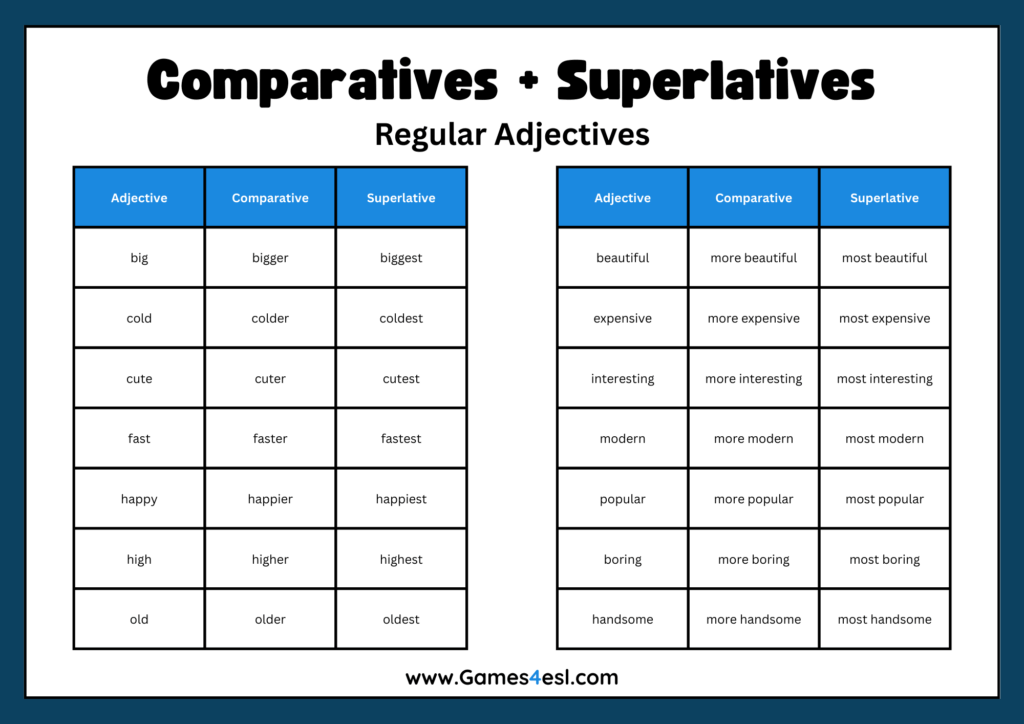
Here’s a list of common regular adjectives in their comparative and superlative forms. As these are regular, they follow the standard formation rules, so you don’t need to memorize each one individually, but it’s still useful to practice them. Use this list to practice recognizing and forming comparatives and superlatives.
| Adjective | Comparative | Superlative |
|---|---|---|
| angry | angrier | angriest |
| beautiful | more beautiful | most beautiful |
| big | bigger | biggest |
| boring | more boring | most boring |
| cheap | cheaper | cheapest |
| clean | cleaner | cleanest |
| clever | cleverer | cleverest |
| close | closer | closest |
| cold | colder | coldest |
| cool | cooler | coolest |
| crazy | crazier | craziest |
| crispy | crispier | crispiest |
| cute | cuter | cutest |
| dark | darker | darkest |
| deep | deeper | deepest |
| dirty | dirtier | dirtiest |
| dry | drier | driest |
| early | earlier | earliest |
| easy | easier | easiest |
| expensive | more expensive | most expensive |
| fast | faster | fastest |
| fat | fatter | fattest |
| few | fewer | fewest |
| fit | fitter | fittest |
| flat | flatter | flattest |
| fresh | fresher | freshest |
| funny | funnier | funniest |
| great | greater | greatest |
| hairy | hairier | hairiest |
| happy | happier | happiest |
| healthy | healthier | healthiest |
| heavy | heavier | heaviest |
| high | higher | highest |
| hot | hotter | hottest |
| hungry | hungrier | hungriest |
| interesting | more interesting | most interesting |
| kind | kinder | kindest |
| large | larger | largest |
| late | later | latest |
| light | lighter | lightest |
| little | littler | littlest |
| long | longer | longest |
| loud | louder | loudest |
| low | lower | lowest |
| modern | more modern | most modern |
| near | nearer | nearest |
| new | newer | newest |
| nice | nicer | nicest |
| old | older | oldest |
| poor | poorer | poorest |
| popular | more popular | most popular |
| quick | quicker | quickest |
| rich | richer | richest |
| sad | sadder | saddest |
| salty | saltier | saltiest |
| scary | scarier | scariest |
| short | shorter | shortest |
| skinny | skinnier | skinniest |
| slow | slower | slowest |
| small | smaller | smallest |
| smart | smarter | smartest |
| soft | softer | softest |
| strong | stronger | strongest |
| tall | taller | tallest |
| thick | thicker | thickest |
| tired | more tired | most tired |
| ugly | uglier | ugliest |
| warm | warmer | warmest |
| weak | weaker | weakest |
| wet | wetter | wettest |
| wide | wider | widest |
| young | younger | youngest |
Comparative And Superlative List – Irregular Adjectives
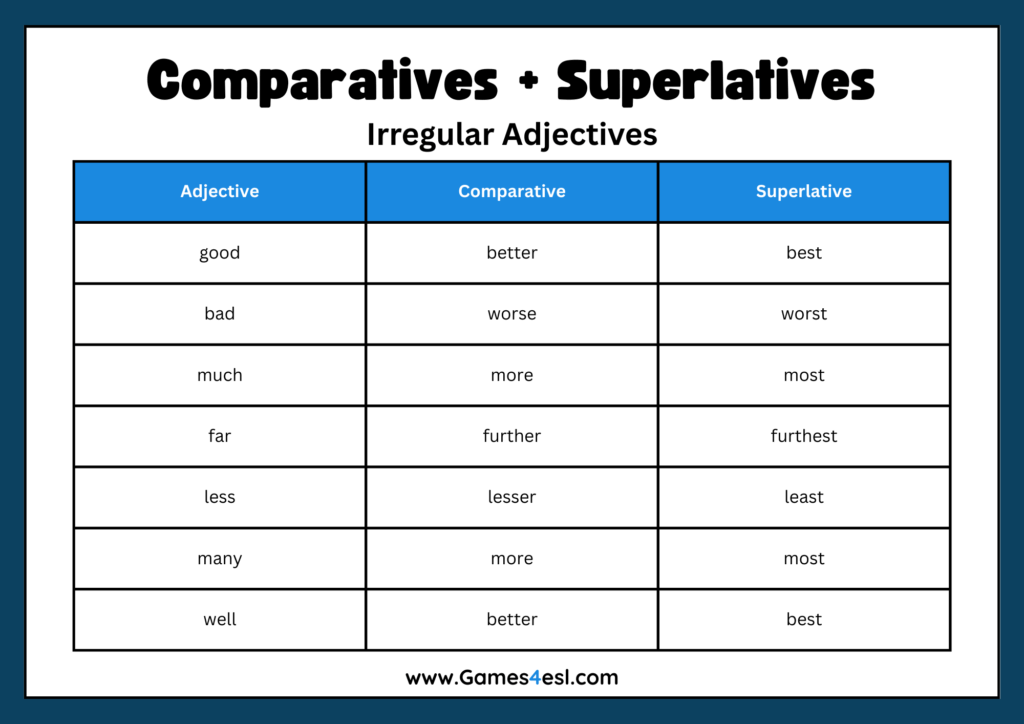
Here’s a list of common irregular adjectives in their comparative and superlative forms. These adjectives do not follow the standard formation rules, so they must be learned and memorized individually. Practicing with these words will help you use them correctly in conversation and writing.
| Adjective | Comparative | Superlative |
|---|---|---|
| good | better | best |
| bad | worse | worst |
| much | more | most |
| far | further | furthest |
| less | lesser | least |
| many | more | most |
| well | better | best |
Related Comparative And Superlative Resources
- Comparative and Superlative Question Examples – Speaking prompts to practice making comparisons.
- Comparative and Superlative Classroom Games – Fun, no-prep activity ideas.
- Comparative Adjective Exercises – Interactive practice for forming and using comparatives.
- Superlative Adjective Exercises – Interactive practice for forming and using superlatives.
- Comparatives PowerPoint Lesson – A ready-to-use presentation to teach comparative adjectives.
- Superlatives PowerPoint Lesson – A ready-to-use PowerPoint to teach superlative adjectives.
About the Author
Written by Craig Comer
Craig Comer is an experienced ESL teacher with over 10 years of classroom experience. He holds a Master’s degree in TESOL and specializes in creating practical resources for English language teachers.