

What Are Adverbs? Definitions, Examples, And Example Sentences
Adverbs are an essential part of English, but they can be confusing for learners because they come in many forms and can appear in different places in a sentence. Unlike verbs or nouns, adverbs don’t follow a single pattern, so students often struggle to know which adverb to use and where to put it.
Once learners have a strong grasp of adverbs, they can describe actions more precisely. They can explain not just what happened but also how, when, where, and to what extent it happened. This makes communication clearer and more natural. On this page, you’ll find clear definitions of the five main types of adverbs, along with lots of example sentences you can use for study or teaching.
What Is An Adverb?
An adverb is a word that modifies other words, such as verbs and adjectives. Adverbs can also modify other adverbs. The way in which an adverb modifies another word depends on the type of adverb it is. There are five main types of adverbs. These are adverbs of time, adverbs of place, adverbs of manner, adverbs of frequency, and adverbs of degree.
The functions of each of these types adverbs are as follows:
- Adverbs of Time – These describe when something happens.
- Adverbs of Place – These describe where something happens.
- Adverbs of Manner – These describe how something happens.
- Adverbs of Frequency – These describe how often something happens.
- Adverbs of Degree – These describe to what extent something happens.
Adverb Examples
Let’s take a look at some adverb examples. Below, you will find many examples of adverbs along with printable PDFs of adverb examples that you can download.
Adverbs Of Time Examples
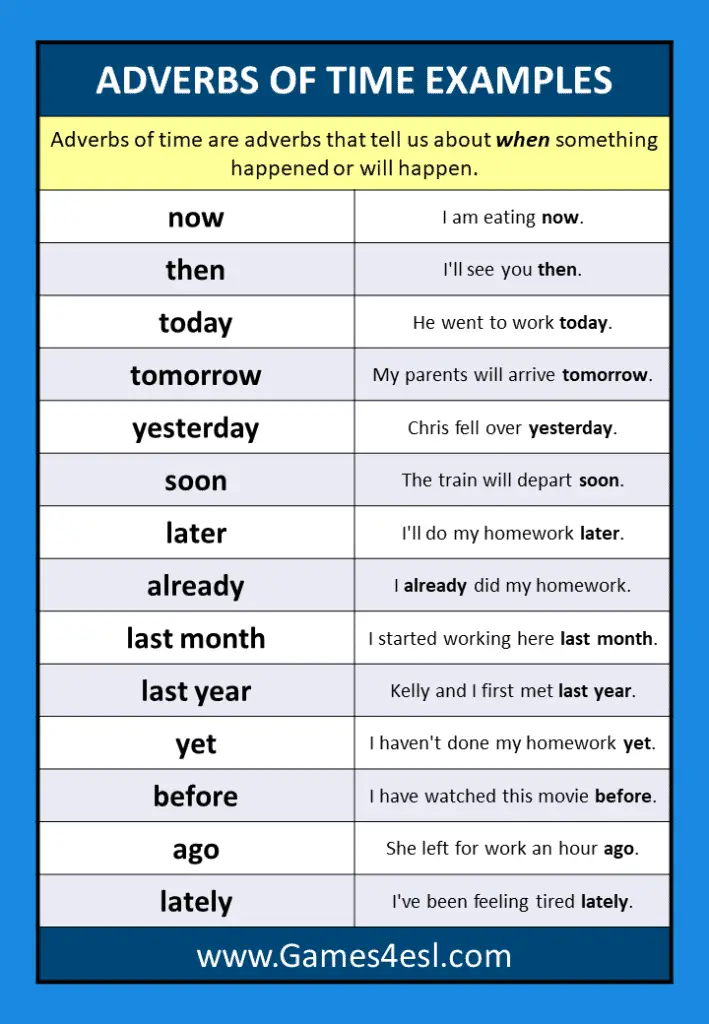
Adverbs of time are adverbs that tell us about when something happened or will happen. Here is a list of common adverbs of time with example sentences. Click here to download this list as a PDF.
- now – I am eating now.
- then – I’ll see you then.
- today – He went to work today.
- tomorrow – My parents will arrive tomorrow.
- yesterday – Chris fell over yesterday.
- soon – The train will depart soon.
- later – I’ll do my homework later.
- already – I already did my homework.
- last month – I started working here last month.
- last year – Kelly and I first met last year.
- yet – I haven’t done my homework yet.
- before – I have watched this movie before.
- ago – She left for work an hour ago.
- lately – I’ve been feeling tired lately.
Adverbs Of Place Examples
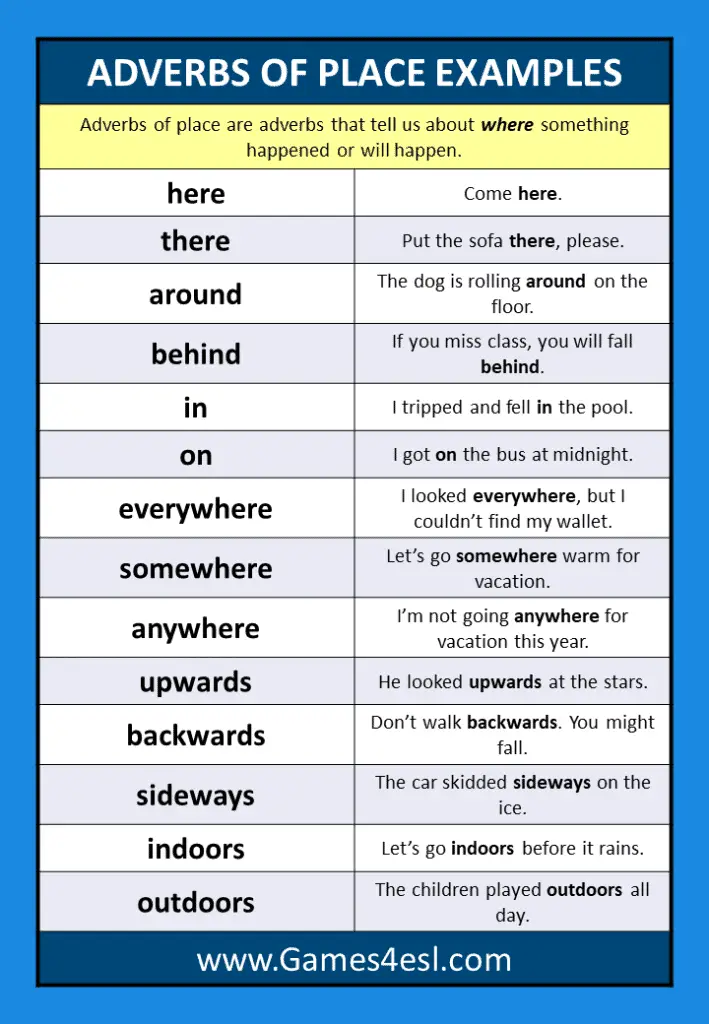
Adverbs of place are adverbs that tell us about where something happened or will happen. Here is a list of common adverbs of place with example sentences. Click here to download this list as a PDF.
- here – Come here.
- there – Put the sofa there, please.
- around – The dog is rolling around on the floor.
- behind – If you miss a class you will fall behind.
- in – Please come in.
- on – Please carry on.
- off – He just drove off.
- over – I almost tripped over on the way here.
- somewhere – Let’s go somewhere warm for vacation.
- nowhere – We went nowhere for vacation last year.
- everywhere – I looked everywhere but couldn’t find my wallet.
- anywhere – I’m not going anywhere for vacation this year.
- upwards – He looked upwards at the stars.
- downwards – The path sloped downwards towards the stream.
- backwards – Don’t walk backwards. You might fall.
- sideways – The car skidded sideways on the ice.
- indoors – Let’s go indoors before it rains.
- outdoors – The children played outdoors all day.
Adverbs Of Manner Examples
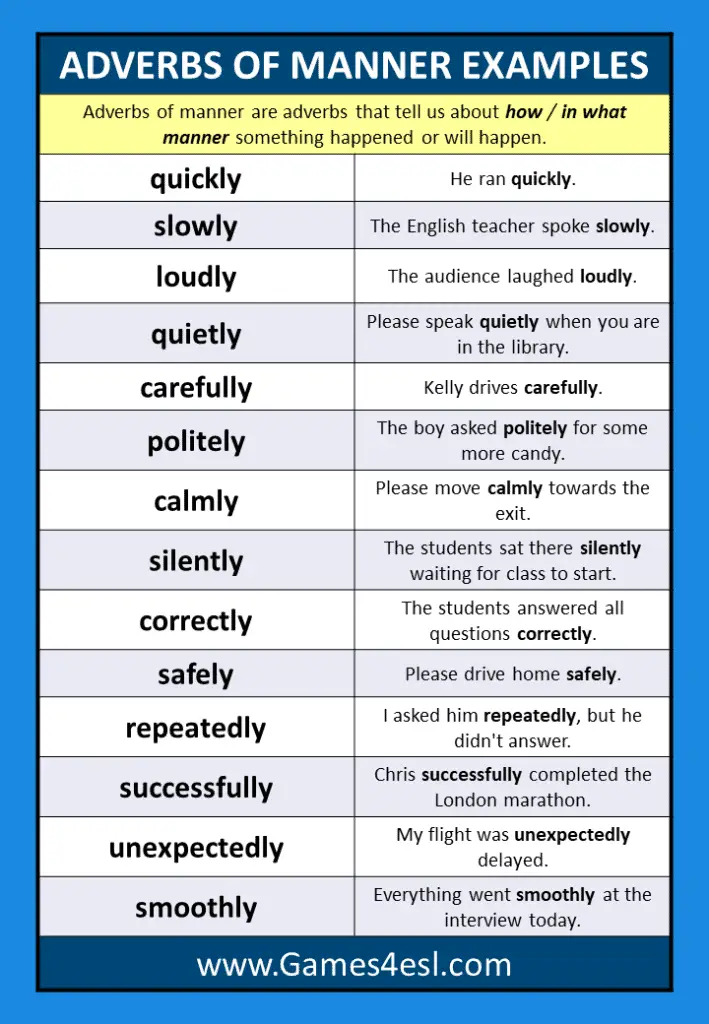
Adverbs of manner are adverbs that tell us about how / in what manner something happened or will happen. Most adverbs of manner end in -ly. Here is a list of common adverbs of manner with example sentences. Click here to download this list as a PDF.
- quickly – He ran quickly.
- slowly – The English teacher spoke slowly so that I could understand.
- angrily – She reacted angrily when she found out.
- calmly – Please move calmly towards the exit.
- carefully – Kelly drives carefully.
- correctly – The students answered all questions correctly.
- loudly – The audience laughed loudly.
- quietly – Please speak quietly when you are in the library.
- politely – The boy asked politely for some more candy.
- seriously – I was seriously hurt in a car crash.
- silently – The students sat there silently waiting for class to start.
- successfully – Chris successfully completed the London marathon.
- unexpectedly – My flight was unexpectedly delayed.
- wisely – Please choose your essay topic wisely.
- suspiciously – He was carrying a suspiciously large amount of money.
- smoothly – Everything went smoothly at the interview today.
- safely – Please drive home safely.
- repeatedly – I asked him repeatedly, but he didn’t answer.
Adverbs Of Frequency Examples
Adverbs of frequency are adverbs that tell us how often or how frequently something happens. Here is a list of adverbs of frequency with example sentences. Click here to download this list as a PDF.
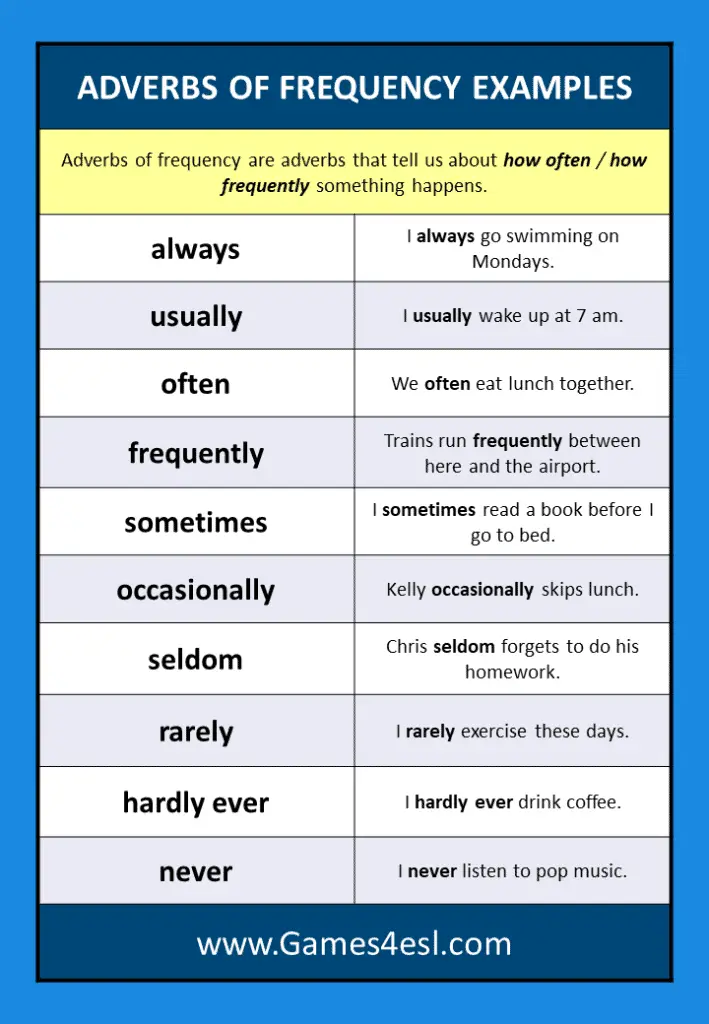
- always – I always go swimming on Mondays.
- usually – I usually wake up at 7 am.
- often – We often eat lunch together.
- frequently – Trains run frequently between here and the airport.
- sometimes – I sometimes read a book before I go to bed.
- occasionally – Kelly occasionally skips lunch.
- seldom – Chris seldom forgets to do his homework.
- rarely – I rarely exercise these days.
- hardly ever – I hardly ever drink coffee.
- never – I never listen to pop music.
Adverbs Of Degree Examples
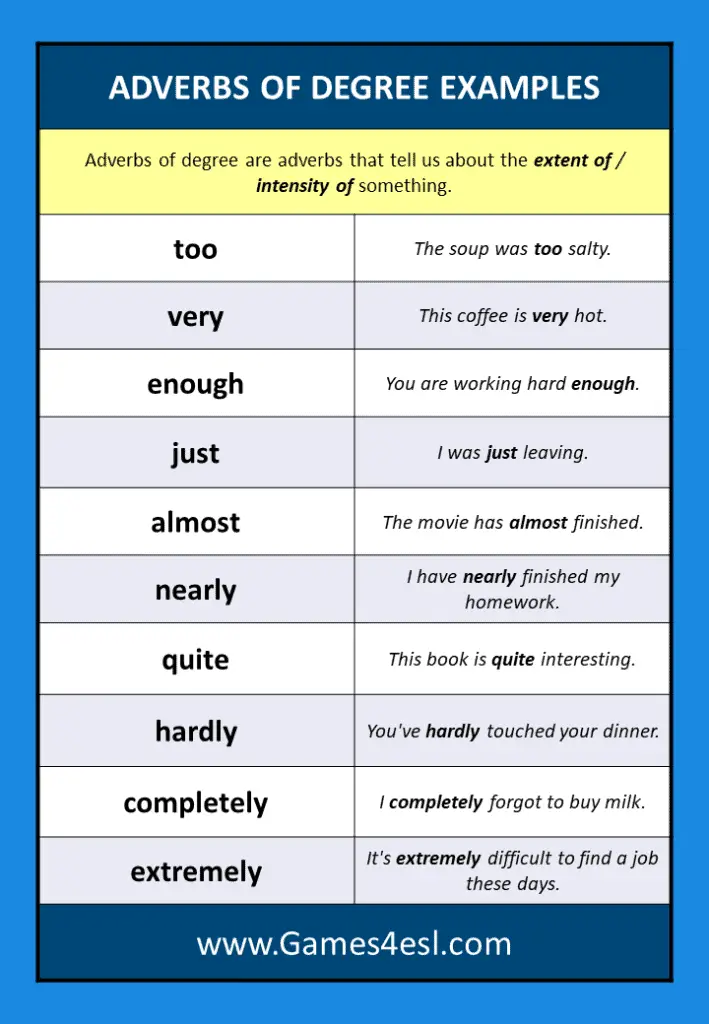
Adverbs of degree are adverbs which tell us about the extent of or the intensity of something. Click here to download this adverbs list as a PDF.
- too – The soup was too salty.
- very – This coffee is very hot.
- enough – You are working hard enough.
- just – I was just leaving.
- almost – The movie has almost finished.
- nearly – I have nearly finished my homework.
- quite – This book is quite interesting.
- hardly – You’ve hardly touched your dinner.
- completely – I completely forgot to buy milk.
- extremely – It’s extremely difficult to find a job these days.
Teaching Resources
If you’re teaching adverbs, here are some free resources you can use in class: