

30 Funny Debate Topics for Beginners That Always Make Students Laugh
Debate class doesn’t always have to be serious. In fact, some of the best classes I’ve had have been when students are debating a silly, funny topic that lets them speak their mind in a no-pressure, enjoyable way. Here are 30 funny debate topics that always make my students laugh and that often lead to some hilarious arguments. All these are simple, easy to understand, and silly, making them perfect for kids and beginner English language learners.
30 Funny Debate Topics for the Classroom

Food Themed
Food is usually the easiest thing for students to talk about because everyone has strong opinions on it. I find these work great for practicing talking about likes and dislikes and descriptive adjectives.
- Is a hotdog a sandwich? (The ultimate class divider).
- Pineapple on pizza: culinary delight or an absolute no-no?
- Should chocolate be considered a vegetable because it comes from beans?
- Is it ethical to eat food that’s fallen on the floor if no one is looking?
- Do vegetables taste better when they are shaped like fries?
- Can you trust someone who doesn’t like ice cream?
- Should candy be considered a food group?
Animal Themed
Talking about animals opens up lots of opportunities for silly conversations because we don’t know what they’re thinking and there’s no right or wrong answer. Encourage students to use their imagination and make their arguments as fun as possible.
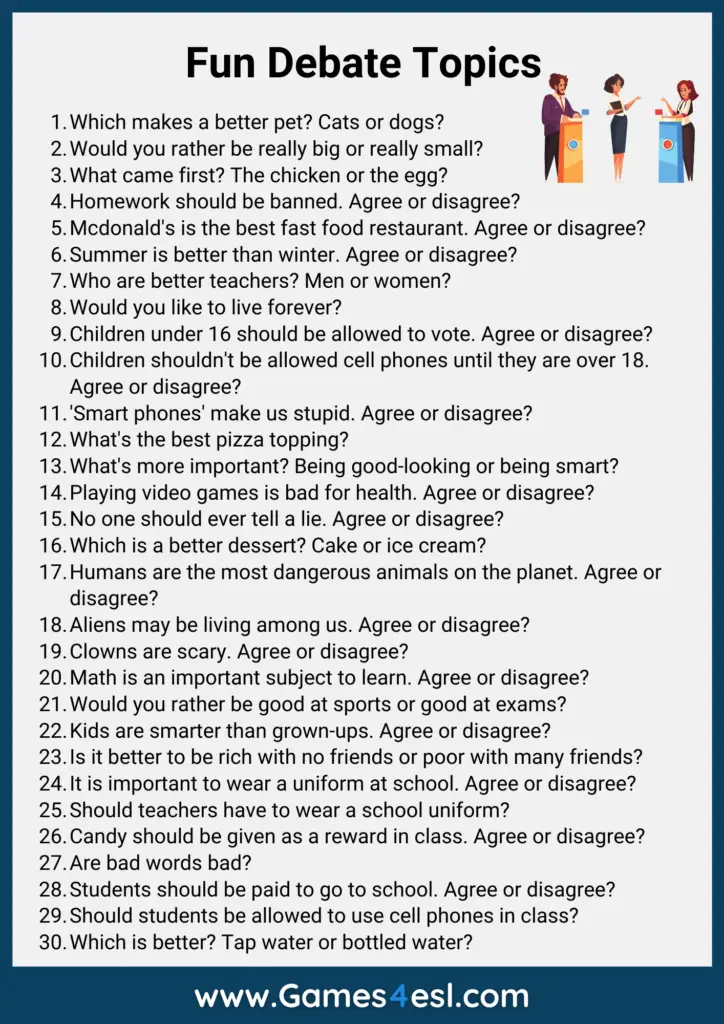
- Which makes a better pet? Cats or dogs? (The classic debate that never gets old).
- Are cats plotting to take over the world?
- Do unicorns get jealous of narwhals?
- Are squirrels secretly spies for birds?
- Do fish get thirsty?
- Are all bugs secretly superheroes with tiny capes?
- Is it possible that every cat is actually a spy?
- Should animals be allowed to compete in the Olympics?
- Is it better to have a dragon or a unicorn as a pet?
- Do birds secretly think they are musicians?
School Related
Using funny school related debate topics in your class gives students a chance to really say what they think. Often with hilarious results.
- Is the zombie apocalypse a valid excuse for not doing homework?
- Should teachers have to wear a school uniform?
- Can you be allergic to homework?
- Students should be paid to go to school. Agree or disagree.
- Should homework be banned on weekends?
- Should pets be allowed in school?
- Should computer gaming be taught in school?
Daily Life Themed
These ones usually make my students laugh the most. Use them as warm-ups or ‘brain-breaks’ to get students energized and ready to learn.
- Is it okay to wear socks with sandals?
- Is water wet, or does it just make other things wet?
- Should everyone have a personal theme song that plays when they walk into a room?
- Is it better to fight one horse-sized duck or a hundred duck-sized horses?
- Should adults be allowed to ride in shopping carts?
- Would you rather be really big or really small? (These questions are always a big hit. Here’s a big list of funny would you rather questions you can use in class.)
Fun Debate Topics PDF
Tips For Conducting A Fun Debate
Once you’ve chosen a funny debate topic, there are some important things you should do before starting the debate to make sure it runs smoothly.
Introduce The Topic
Before starting your classroom debate, be sure to introduce the topic to students and make sure they understand what they will be debating. This is especially important when you are conducting a debate in an ESL class where English is not the students’ native language. Introduce the topic and ask students about their initial thoughts. Elicit some key vocabulary and expressions that your students may need when arguing their case.
Establish The Debate Rules
Even though students will be discussing a funny debate topic, they can still get quite emotional when arguing their case with their classmates. Be sure to establish the debate rules to make sure that students listen to one another and respect each other’s opinions.
Some good debate rules to follow are:
- Do not interrupt when others are speaking.
- Keep your answers short and concise.
- Listen carefully to your opponent and ask questions once they have finished.
- No idea is a stupid idea.
- Do not raise your voice.
- Always speak calmly and politely to your opponent.
Give Students Time To Research The Debate Topic
The best debates are ones in which students can back up their opinions with facts. If possible, give your students time to conduct some research about the debate topic. This can be as simple as letting students use their cell phones in class. Or, if you have a computer room in your school, students can use the internet to research.
Give Students Time To Prepare Their Argument
Once students have conducted some research, it’s time for them to prepare their arguments. Have students write down their arguments. Then, encourage students to anticipate how their opponent will respond and prepare an answer. Even when debating a funny debate topic, giving students time to prepare will make the debate much more fun and educational. Download this debate planning worksheet to help your students prepare their opening statements and arguments.
Keep Track Of Time
To make sure your debate is fair and each side gets the same chance to lay out their argument, it is important to keep track of time. A great way to do this is to use a visual classroom timer so that both you and your students can see how much time they have. Using the classroom timer, give the first team 2 minutes to present their argument. Then, give the other team 2 minutes to present their case. Then, give both teams a few minutes to prepare their rebuttal. Next, give each team 2 minutes to present their rebuttal and their final summary of their argument.