
CVCC Word List – With Teaching Ideas and Printable PDF
When children are learning to read, they typically learn CVC words first and then progress onto CVCC words (Consonant–Vowel–Consonant–Consonant). CVCC words, such as lamp or jump, end with a consonant blend. Learning these words helps students see how blending two consonant sounds together at the end of a word can create a new sound.
To help you teach these words to early readers, we’ve put together a useful list of CVCC words you can use for practice. The list is also available as a printable PDF, so you can display it in class or hand it out to students. You’ll also find practical teaching ideas to make learning CVCC words more engaging and effective for young readers.
CVCC Word List
CVCC words are four-letter words that end with two consonants (e.g., lamp, jump, hand). They’re usually taught after CVC and before CVCE because they keep the short vowel sound found in CVC words and add just one more consonant at the end. This lets children focus on blending at the end of words before learning the “silent e” pattern that changes the vowel sound. Here’s a list of CVCC words, grouped by their ending sounds, that you can use when teaching early readers.
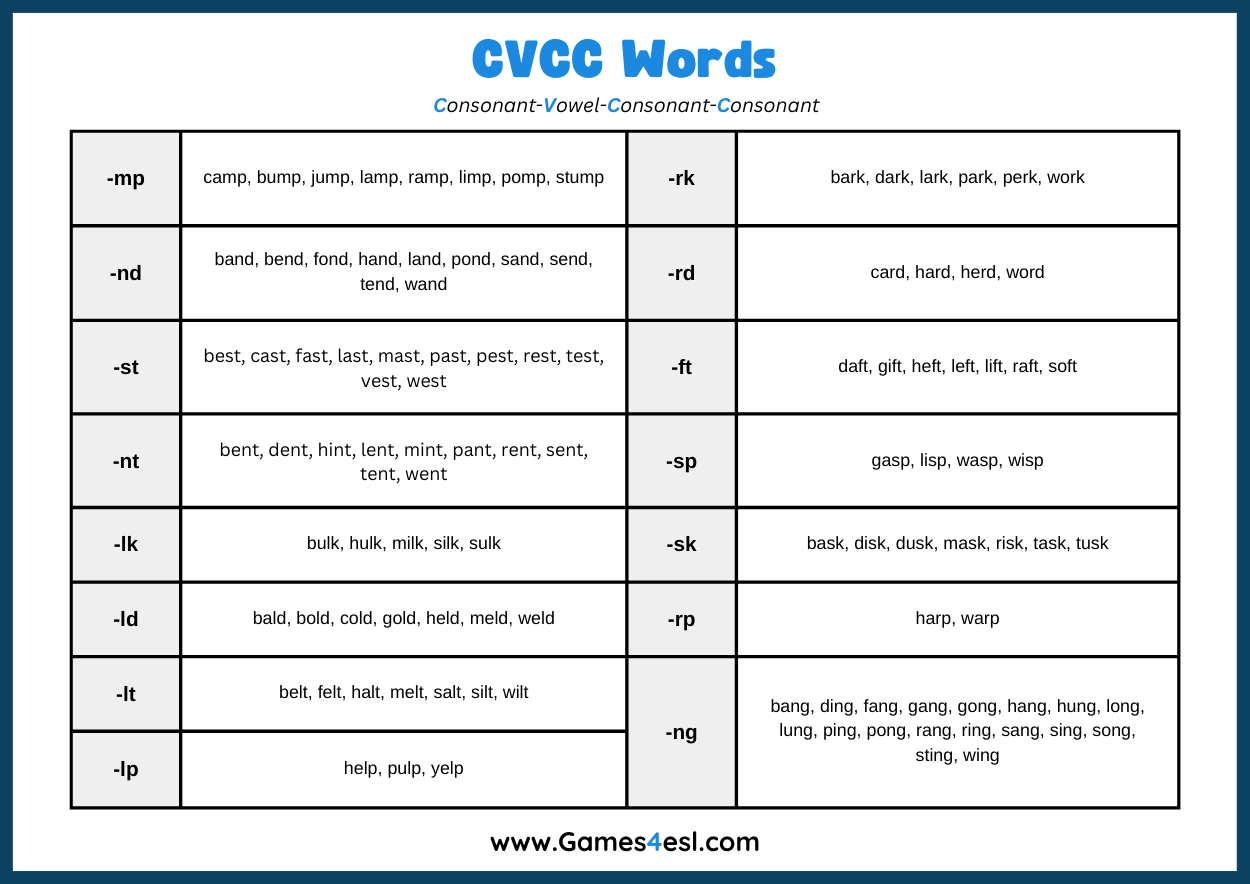
| Ending Blend | CVCC Words |
|---|---|
| -mp | camp, bump, jump, lamp, ramp, limp, pomp, stump |
| -nd | band, bend, fond, hand, land, pond, sand, send, tend, wand |
| -st | best, cast, fast, last, mast, past, pest, rest, test, vest, west |
| -nt | bent, dent, hint, lent, mint, pant, rent, sent, tent, went |
| -lk | bulk, hulk, milk, silk, sulk |
| -ld | bald, bold, cold, gold, held, meld, weld |
| -lt | belt, felt, halt, melt, salt, silt, wilt |
| -lp | help, pulp, yelp |
| -rk | bark, dark, lark, park, perk, work |
| -rd | card, hard, herd, word |
| -ft | daft, gift, heft, left, lift, raft, soft |
| -sp | gasp, lisp, wasp, wisp |
| -sk | bask, disk, dusk, mask, risk, task, tusk |
| -ng | bang, ding, fang, gang, gong, hang, hung, long, lung, ping, pong, rang, ring, sang, sing, song, sting, wing |
| -rp | harp, warp |
Download the CVCC Word List
Download this printable version of the CVCC word list and display it in class or hand it out to students.
How to Teach These CVCC Words
CVCC words are best taught once children are confident with simple CVC words. The aim is to show that the short vowel sound stays the same, but two consonants are blended at the end. Here are some useful techniques you can try:
- Review CVC words – Start by revisiting simple CVC words that children already know. This reinforces the short vowel sound and prepares students to read CVCC words, which also contain the same short vowel sound.
- Introduce blends – Choose a simple CVCC word like jump and sound out each letter slowly. Then blend the last two sounds together: j – u – mp. Highlight how m and p join to make a smooth ending. Practise with a few more examples, such as hand or best. You can even ask students to predict what the blend will sound like before you model it (e.g., “What do n and d sound like together at the end of a word?”).
- Use word chains – Create sets of CVCC words where only one sound changes at a time. This gives students lots of practice blending CVCC endings. For example,
- Keep vowel the same, change first sound: jump → bump → lump → dump
- Keep end blend the same, change vowel: jump → jamp → jemp → jomp
- Practice regularly – Children won’t master all blends in one sitting. They need repeated exposure over time, so make CVCC practice part of your daily lesson routine. Include reading individual words and short, simple sentences with CVCC patterns in every session to build fluency step by step.
What to Teach After CVCC Words
Once children are confident reading and spelling CVCC words, the next step is usually CVCE words (often called “magic e” or “silent e” words). In CVCE words, the final e changes the short vowel into a long vowel sound, for example, cap → cape or hop → hope. See the CVCE Word List and Teaching Guide.