
Countries and Nationalities PowerPoint
This PowerPoint is designed to introduce the names of countries and nationalities in English. It’s ideal for English lessons teaching how to ask and answer “Where are you from?” Students will learn the names of 24 countries and nationalities, play a fun guessing game, and practice making a dialogue. Download the PowerPoint below.
Countries and Nationalities PPT
How to Use the PowerPoint
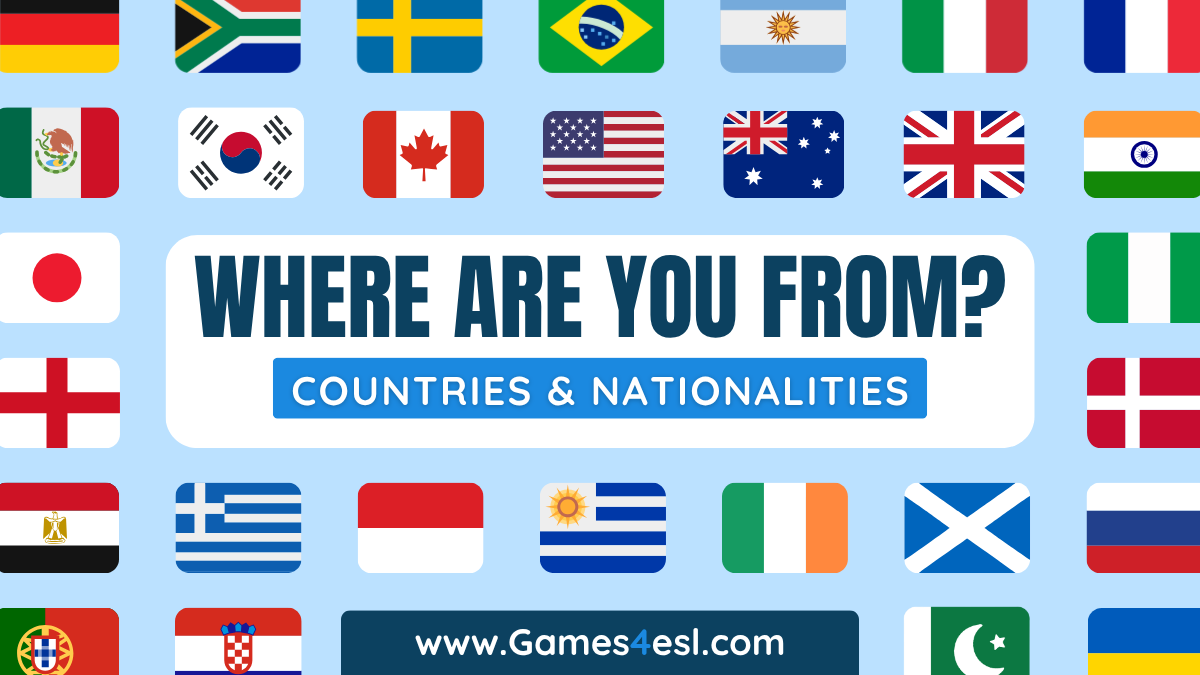
Start the presentation, and on the first slide you’ll see many different country flags. You can use this slide to introduce the topic of the lesson and to put the lesson into context. I like to begin by asking students to identify which flags/countries they already know. I then ask students if they have ever been to any of these countries. This warm-up discussion helps to put the concept of countries into context.
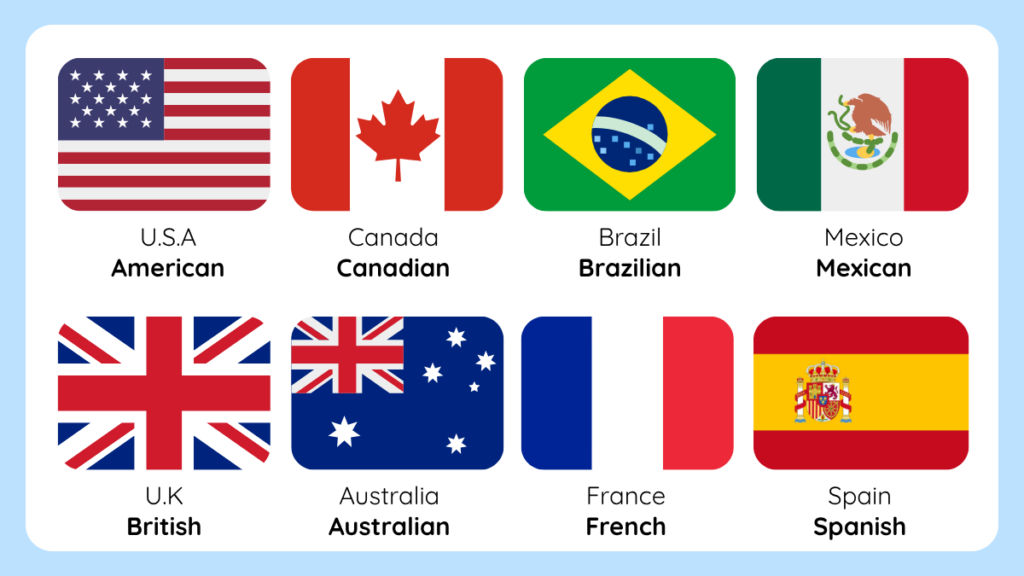
Next, use the PowerPoint slides to teach 24 country names. The country names included are the U.S.A., Canada, Brazil, Mexico, the U.K., Australia, France, Spain, Germany, Italy, Sweden, Switzerland, Egypt, South Africa, Greece, Ireland, China, South Korea, Japan, India, Vietnam, Thailand, the Philippines, and Russia. There are, of course, many more countries, but I find this is a good group of countries to use when teaching beginners.
Once students have learned the country names, use the guessing game in the PPT to practice asking and answering “Where are you from?” There are 10 rounds, and each one will show a country flag hidden behind some colored shapes. Students must guess the country and then answer the question “Where are you from?” using a full sentence. For example, “I’m from Canada.” Once a student has guessed correctly, I like to then ask the whole class “Where are you from?” and have them answer chorally for extra practice.
After the game, students will learn the nationalities that match the country names. At this point, I like to point out that although there are some common patterns with nationality names, it’s best to memorize each one to avoid mistakes. Go through each country and nationality, practicing the pronunciation together as a class. Finally, use the example dialogue to practice using the country and nationality names in natural conversation. After practicing a few times together as a class, I like to put students into pairs and have them come up with their own dialogue by swapping out the names, country names, and nationality names for different ones, before sharing their dialogue with the class.