How to Teach The Past Simple Tense | Step By Step
Learning the past simple tense is an important step for English language learners. Once students understand the past simple, they can talk about what they did yesterday, describe past experiences, and begin to communicate real-life events with much more confidence. There are many different ways to teach the past simple tense, and the best approach often depends on your students’ level and age. Here’s the method I’ve found works best with beginners of any age.
In this step-by-step guide, you’ll learn how to teach the past simple tense using a clear lesson structure that covers regular and irregular verbs, negative forms, and question forms. The approach below is based on practical classroom experience and is designed to help students not only understand the rules, but to actually use the past simple tense when speaking in English.
Because there’s a lot to cover, it’s best to teach it over several lessons rather than trying to do everything at once. Follow the steps below to build your students’ confidence gradually, avoid common mistakes, and get them using it naturally in conversation.
Teaching The Past Simple Tense
Step 1: Context
Before teaching the different past simple forms, it’s important to first put the lesson into context so students have a clear sense of what the past tense means. Without this, students, especially younger learners, can struggle to understand when and why to use it.
In my experience, one of the simplest and most effective ways to do this is to draw a timeline on the board. Draw a line, mark “Today” in the center, and then ask students to suggest past time expressions such as yesterday, last week, and last year.
Use this timeline to show that we use the past tense to talk about events that happened before now. Once students understand this basic idea, you can move on to introducing regular past simple verb forms.
Step 2: Regular Verbs
Choose a regular verb and write an example sentence in the present simple tense on the board. For example, I walk to school every day. Then change this sentence into the past simple (I walked to school yesterday) and write that on the board as well. Use the timeline from earlier to show this sentence is talking about the past.
Next, ask students to compare the verb (walk/walked) in the two sentences and identify how the verb has changed. Most students will notice that -ed has been added to walk to form the past tense. Explain that regular verbs form the past simple by adding -d, -ed, or -ied, and give students plenty of examples to practice.
In my experience, it usually takes one or two lessons for students to become confident using these patterns and get used to the spelling rules. Use this Past Simple Tense PowerPoint to teach the rules and guide students in forming their own past tense sentences.
Step 3: Irregular Verbs
Now that students understand that to form the past tense they need to change the verb, it’s time to introduce irregular verbs. One simple method I use is to write a present simple sentence on the board with an irregular verb, for example I speak English every day, and then ask students to guess the past tense form.
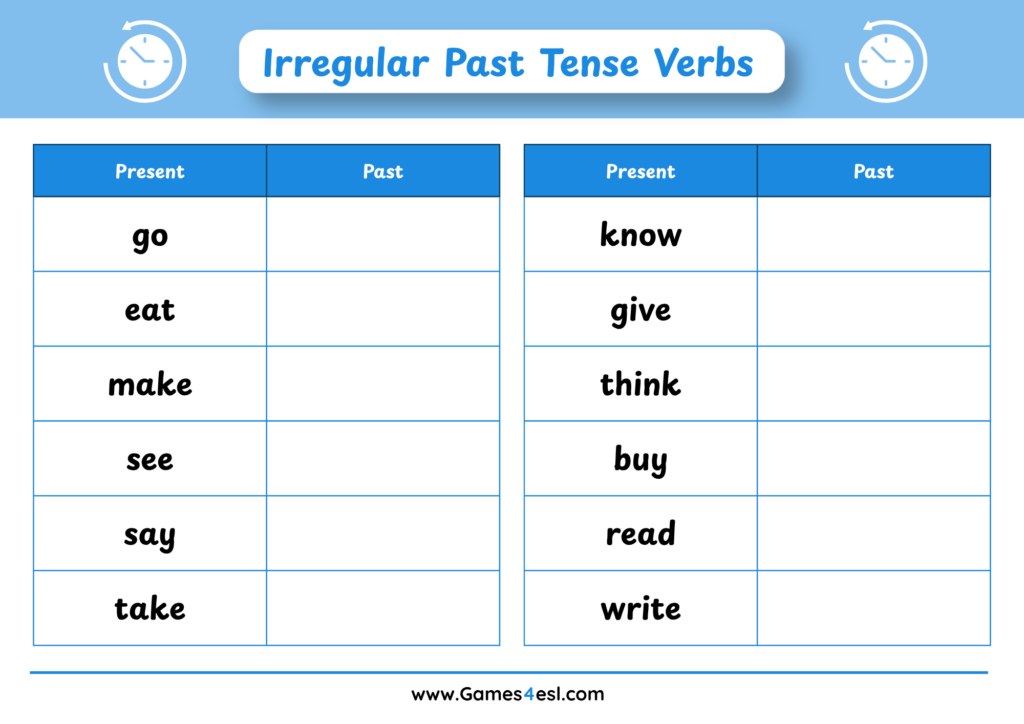
In my experience, students will often guess that the past tense of speak is speaked. This creates a perfect opportunity to show that irregular verbs do not follow the same rules and need to be learned individually. As there are many irregular verbs, it’s best to start by teaching a small number of common ones. Use this worksheet to introduce 12 common irregular verbs and their past tense forms, and then introduce new verbs over the next few lessons for students to memorize.
Step 4: Negative Forms
Teaching the past simple negative form is quite straightforward once students know how to make past simple sentences. Explain that to make a negative sentence in the past simple, you add did not before the base form of the verb. For example, I did not meet Chris yesterday.
Then give students plenty of opportunities to practice making negative sentences. A simple way to do this is to go around the class and ask each student to say one affirmative past simple sentence and one negative sentence. For example, I met Sally yesterday. I did not meet Chris yesterday. After each student speaks, ask the rest of the class to change the sentences into the third person. For example, She met Sally yesterday. She did not meet Chris yesterday.
Step 5: Questions
Once students are comfortable with affirmative and negative sentences, it’s time to introduce past simple questions. Write a few example questions on the board, such as Did you go to school yesterday? and Did she play football last weekend? Draw students’ attention to how the question begins with did and how the verb changes back to its base form. Explain that because did is already in the past tense, the main verb does not need to change. This helps prevent a common mistake where students use the past form for both did and the main verb, for example “Did you went…” instead of “Did you go…”.
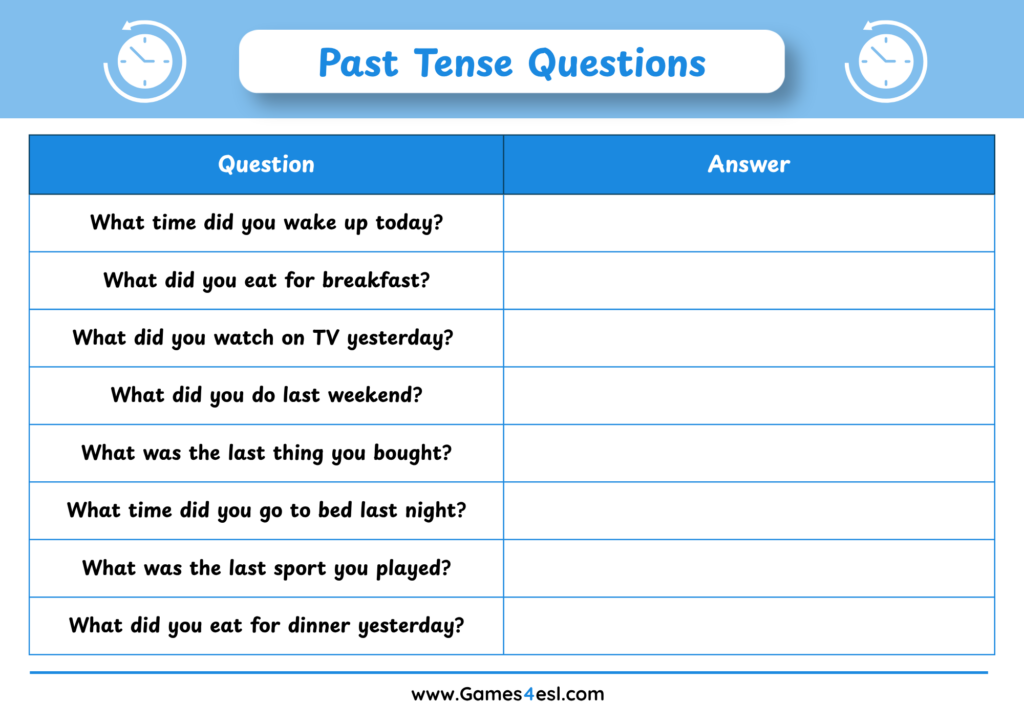
After demonstrating how to form past tense questions, practice asking and answering past tense questions with this worksheet. Give each student a copy and read the questions together as a class. For each question, elicit an example answer and write it on the board. Then have students write their own answers on the worksheet. Once the worksheet is complete, have students use it to ask and answer the questions with a partner. If these questions are too hard for your students, here are many more past tense questions you can use.
Step 6: Practice Activities
To help students become more confident using the past simple, it’s important to give them plenty of practice with both regular and irregular verbs. Use the following exercises and worksheets to give students additional practice. These can be used in class or set as homework to reinforce what they have learned:
- Past Simple Regular Exercises
- Past Simple Irregular Exercise
- Exercise Worksheet 1 – Regular Verbs
- Exercise Worksheet 2 – Irregular Verbs
- Exercise Worksheet 3 – Irregular Verbs
Step 7: Review Games
As you teach the past simple over several lessons, it’s important to regularly review key forms so students don’t forget them. Using games and speaking activities is a great way to reinforce what students have learned while keeping lessons engaging. Here’s an example activity you can use, and you can find more past simple games here.