

Can/Can’t Lesson Plan for ESL Beginners
This can/can’t lesson plan is designed for kids and beginner ESL students to practice talking about abilities. Using can and can’t to describe what you are able (or unable) to do is one of the most useful early grammar points, and it quickly leads to meaningful communication. The lesson plan below is complete with all the materials you need, including activities and printable resources.
Lesson Overview
- Objectives: Students will be able to use action verbs with can and can’t to talk about their abilities and ask/answer simple questions.
- Key Expressions:
- “I can (swim).” / “I can’t (fly).”
- “Can you (cook)?” → “Yes, I can.” / “No, I can’t.”
- Who it’s for: Beginner ESL/EFL Kids.
- Duration: 40–60 minutes.
Introduction to Can/Can’t and Warm-up
A fun way to begin the lesson is with an action verbs guessing game video. This activates students’ existing knowledge of action verbs and gives you a natural way to introduce can/can’t. After students guess a verb, pause the video and ask them a question using that verb. For example: “I can jump. Can you jump?” This shows students that can/can’t is used to talk about abilities in a simple, memorable way.

Practice Key Words And Sentences

Next, it’s time to introduce the key words for the lesson. Using these action verb flashcards, have students repeat each word after you. The words included are fly, run, jump, skate, ski, cook, sing, and dance. Once students are confident with the words, practice the key expressions by combining them with the verbs. For example:
- “I can (swim).”
- “I can’t (fly).”
- “Can you (cook)?” → “Yes, I can.” / “No, I can’t.”
Activity 1: Can/Can’t Four Corners Game

This energetic activity works well to practice can/can’t with action verbs.
- Place one action verb flashcard in each corner of the classroom (e.g., run, jump, swim, cook).
- Give students five seconds to choose a corner. While they move, secretly write down one verb.
- Call out a sentence with can + that verb, e.g., “I can swim.”
- Students in the “swim” corner are out and sit down.
- Repeat with new verbs until one student is left. That student is the winner and gets to choose the verbs for the next round.
Safety tip: Remind students not to run or push, and clear the floor of bags or obstacles to keep the game safe.
Activity 2 – Can/Can’t Board Game
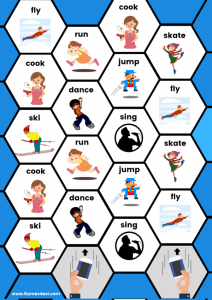
This board game is best played in pairs and is designed to get students speaking in complete sentences and practicing real dialogues about their abilities. Before class, download this can/can’t board game and print enough so you have one for every two students.
How to Play:
- Each pair needs one eraser and one pen.
- Students take turns flicking the eraser up the board.
- If it lands on a picture (e.g., “cook”), one student asks: “Can you cook?” The other replies with either “Yes, I can.” or “No, I can’t.”
- After completing the dialogue, the student writes their name in that space.
- The player with the most spaces at the end wins.
This activity works well because every turn requires students to produce both questions and answers, giving them lots of speaking practice. For more games like this, see our printable board games page.
Activity 3 – Act It Out and Find a Partner
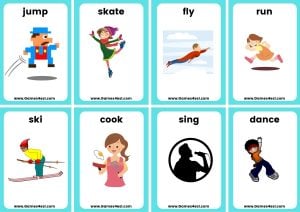
Give each student one of these small action verb flashcards. Without showing others, they must mime the action and find a partner with the same card. Example: students with “jump” jump around the classroom until they meet. Then they ask and answer:
- “Can you jump?”
- “Yes, I can.”
They show the teacher and sit down. With a big class, ask students to find 2–3 matching partners for more fun.
Review
To review the lesson, go through the action verb flashcards again. Hold up a card and ask the class, “Can you (dance)?” Students answer “Yes, I can” or “No, I can’t” based on their real abilities. Encouraging them to answer like this makes them think about what they can and can’t do and use the target language in a real, communicative way.
As one final review, have students line up and quickly ask each one a question about their abilities before they leave the classroom. This gives every student a chance to respond individually and helps you check who is confident and who may need more practice.
Additional Resources for Can/Can’t Lessons
Here are some more free and useful resources you can use when teaching lessons about abilities: