
Parts Of Speech Quiz (With Free PDF)
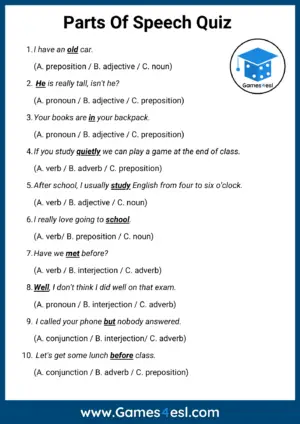
This parts of speech quiz will test how well you can identify different types of words in English. The quiz has 10 questions covering nouns, verbs, adjectives, adverbs, pronouns, prepositions, conjunctions, and interjections. In each question, you’ll see a sentence with one word underlined. Choose the correct part of speech from the answers provided.
Take the Parts Of Speech Quiz
Printable Parts of Speech Quiz
Here’s a printable version of the quiz that you can hand out to students to complete in class or at home.
Review: Parts of Speech In English
If you found some of the questions in the quiz tricky, review the eight parts of speech below. Read the definitions and examples to learn how each one is used, then try the quiz again and see if you can improve your score.
Nouns
Nouns are words that name people, places, things, or ideas. For example, brother, Spain, phone, and happiness are all nouns.
- My brother lives in Spain.
- She left her phone at home.
- Happiness is more important than money.
In these examples, brother names a person, Spain names a place, phone names a thing, and happiness names an idea or feeling.
Pronouns
Pronouns are words that are used instead of nouns. For example, she, I, and they are all pronouns.
- She works in a hospital.
- Tom called me, but I didn’t answer.
- My parents are at home. They are watching TV.
In these examples, she, I, and they refer to people without repeating their names.
Verbs
Verbs are words that describe actions or states. For example, study, walk, and know are all verbs.
- We study English every day.
- She walked to work this morning.
- I know the answer.
In these examples, study and walked describe actions, while know describes a state.
Adjectives
Adjectives are words that describe people or things. They give us more information about what someone or something is like. For example, small, kind, and difficult are all adjectives.
- They live in a small apartment.
- My grandfather is very kind.
- It was a difficult exam.
In these examples, small describes the apartment, kind describes the grandfather, and difficult describes the exam.
Adverbs
Adverbs give us more information about an action, such as how, when, or where it happens. For example, fluently, early, and outside are all adverbs.
- She speaks English fluently.
- We arrived early.
- The children are playing outside.
In these examples, fluently tells us how she speaks, early tells us when we arrived, and outside tells us where the children are playing.
Prepositions
Prepositions show how people or things are related by place, time, or direction. For example, on, at, and to are all prepositions.
- The keys are on the table.
- We have class at nine o’clock.
- She walked to the station.
In these examples, on shows the location of the keys, at shows the time of the class, and to shows the direction of movement.
Conjunctions
Conjunctions are words that join words, phrases, or parts of a sentence. For example, and, but, and because are all conjunctions.
- I bought some bread and milk.
- I called him, but he didn’t answer.
- We stayed home because it was raining.
In these examples, and joins two things, but joins two contrasting ideas, and because gives the reason for staying home.
Interjections
Interjections are words or short expressions that show a reaction, feeling, or thought. For example, wow, ouch, and well can all be used as interjections.
- Wow! That’s an amazing view.
- Ouch! That really hurt.
- Well, I’m not sure that’s a good idea.
In these examples, wow shows surprise or admiration, ouch shows pain, and well introduces the speaker’s thought or reaction.