
Future Simple Tense With Will PowerPoint
This Future Simple Tense PowerPoint is designed to help English language learners understand how to form and use the future tense with will. It teaches what the future tense is, how to form positive and negative sentences, and provides plenty of opportunities for students to make their own future simple sentences. Download the PowerPoint below.
Future Simple With Will PowerPoint
Inside this PPT
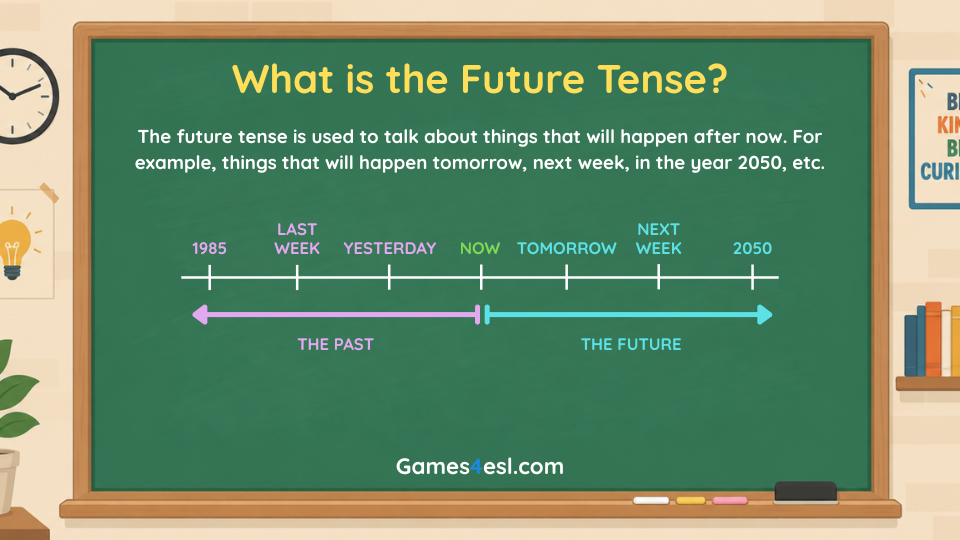
This PowerPoint lesson introduces the future tense step by step, beginning with a simple explanation of what the future tense is and when we use it. Students are then shown how to form sentences with will, including positive and negative forms, as well as common contractions such as I’ll and won’t.
The presentation also includes clear example sentences, question-and-answer practice, and activities where students change positive sentences into negative ones. It finishes with a speaking activity where students take turns asking and answering future tense questions with a partner.
Tips for Using This PPT
Before starting the future tense PowerPoint, I find it useful to draw a simple timeline on the board and quickly review concepts such as the present, or “now,” and the past. I usually elicit a few past time expressions from students, such as yesterday, last week, last year, and 1980, before introducing future time expressions like later, tomorrow, next week, and next year. I find this helps put the lesson into context from the beginning. It is also useful to leave the timeline on the board so you can refer back to it throughout the lesson.
As you work through the example sentences in the PowerPoint, show students how they can easily swap out the subject, verb, or time expression to make a new sentence of their own. I find that doing this regularly throughout the lesson gives students lots of small opportunities to practice, which helps build their confidence before they get to the speaking activity at the end.
One other thing I recommend is reminding students throughout the lesson that the base verb always stays the same after will. If students have already learned the present simple tense, a common mistake is to add an -s to the verb with subjects such as he and she. For example, students may say She will plays instead of She will play. Highlighting this early and repeating the rule as you go can help prevent that mistake before it becomes a habit.
More Future Tense Teaching Resources
- Future Tense Worksheets
- Future Tense with Will Lesson Plan
- Future Simple Tense Games
- Future Simple Online Quiz