
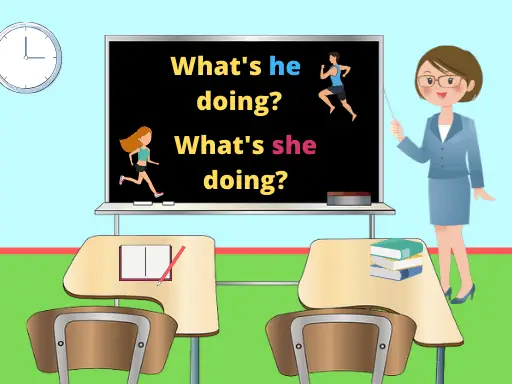
Present Continuous Tense – A Complete ESL Lesson Plan
The present continuous tense (also called the present progressive) is one of the first tenses ESL learners study. It is used to talk about actions that are happening right now, and is easy to demonstrate with simple actions. Words like eating, reading, running, and dancing can be understood by students simply by acting them out in class.
This present continuous lesson plan is designed for beginner students, especially young learners, and includes all the materials you need. Students will practice asking and answering questions such as “What is he doing?” → “He is eating.” and “What are they doing?” → “They are dancing.” through fun games and speaking activities.
Lesson Overview
- Objectives: Students will be able to use the present continuous tense to describe actions happening now. They will practice forming sentences and asking/answering simple questions.
- Key Expressions:
- He is (eating).
- She is (reading).
- They are (dancing).
- What is he/she doing? → He/She is (running).
- What are they doing? → They are (singing).
- Who it’s for: Beginner ESL/EFL kids.
- Duration: 40–60 minutes.
Introduction and Warm Up
A fun way to introduce the present continuous tense is with a song. This song by the Silly Billy Band is perfect for beginners and always gets kids laughing. Play the song and ask students to listen for words ending in –ing. Afterward, invite them to share any verbs they remember and write them on the board.
Next, put these words into context. The present continuous describes actions happening right now, so the easiest way to show this is to act them out. For example, pick up a book, pretend to read, and say, “I am reading.” Go through the other verbs from the song in the same way. As you model each sentence, have students copy both the action and the words.
To reinforce the structure, play the song again. Pause after each action and ask the class, “What is he doing?” or “What is she doing?” Students answer using the target language.
Practice Present Continuous Verbs and Sentences
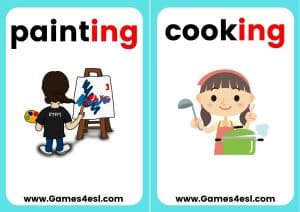
Use these present continuous flashcards to introduce the key vocabulary. Show each card, say the word, and have students repeat after you. Then ask them to try saying the words on their own. Next, draw students’ attention to the pictures. Ask whether they see a boy or a girl, and explain that we use he for boys and she for girls. Practice simple questions and answers with the flashcards:
- What is he doing? → He is running.
- What is she doing? → She is reading.
Activity 1: Pass the Ball Game – What is he/she doing?
Now that students have practiced basic present continuous sentences, it is time to use them in a fun activity. This pass-the-ball game works especially well with young learners, who may be shy or hesitant to speak at first. Because the focus is on the game, they can practice the target language while having fun and without feeling self-conscious.
How to Play
- Play music while students pass a ball around the class.
- When the music stops, the student holding the ball comes to the front.
- Show that student a flashcard (for example, running). The student acts out the action.
- Ask the class, “What is he/she doing?” Students answer using the target sentence.
Variation: To practice “What are they doing?”, have the student at the front close their eyes while the teacher shows the flashcard to the rest of the class. All students act out the word together, and the student at the front must guess: “What are they doing?”
Safety Tip: Remind students to pass the ball gently rather than throw it, and show them which direction to pass it to keep the activity organized and safe.
Activity 2: Board Game – Race Around the World
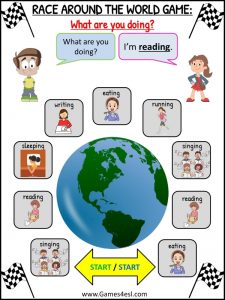
This board game is best played in pairs and gives students plenty of practice making short dialogues with present continuous verbs.
To play, give each pair of students a copy of this board game and have them place their erasers at the “Start.” One student moves clockwise, and the other moves counterclockwise. To decide who gets to move their eraser, students play rock, scissors, paper. The winner moves their eraser one space, and then the students make a dialogue based on the picture in the square:
- Student A: “What is he doing?”
- Student B: “He is eating.”
As a variation, students can ask, “What are you doing?” and their partner answers while acting it out (for example, “I am dancing.”). The first student to make it all the way around the board is the winner.
Activity 3: Level Up Game – What are you doing?
This final activity is a lively speaking game that gets the whole class moving while practicing present continuous questions and answers. Young learners especially enjoy it because they get to do silly actions as they move around the class.

How to Play
- Place one present continuous flashcard in each of the four corners of the room. Each corner represents a different level (for example: Level 1 = dancing, Level 2 = eating, Level 3 = jumping, Level 4 = swimming).
- All students begin at Level 1 and act out the action for that corner.
- Students pair up and ask/answer the question:
- A: “What are you doing?”
- B: “I am dancing.”
- After the dialogue, they play rock, scissors, paper. The winner advances to the next level, while the other stays at their current level.
- Play continues, with students moving up levels as they win. When a student passes all four levels, they receive a point or sticker from the teacher and return to Level 1.
- After 5-10 minutes, stop the game. The student with the most points is the winner.
Tip for teachers: Model the activity clearly before starting, and remind students not to run or push since they will be moving around the room.
Review
At the end of the lesson, review the key vocabulary and sentences. One simple way is to act out several present continuous verbs and have students guess what you are doing. To make it more engaging, invite students to the front to act out an action. The rest of the class asks and answers using the target structure:
- “What is he doing?” → “He is running.”
- “What is she doing?” → “She is reading.”
More Present Continuous Resources
Feel free to adapt this lesson plan to suit your class and objectives. Here are some more free resources you can add to this lesson: