
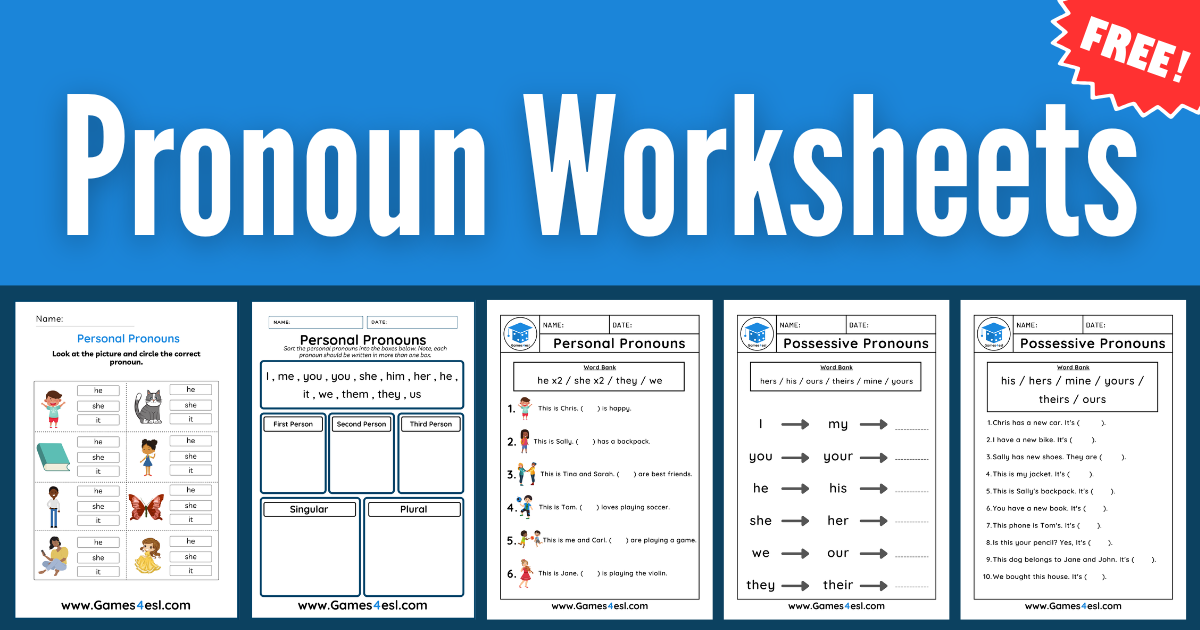
Pronoun Worksheets – Personal, Possessive, and Demonstrative
Download free, printable worksheets for teaching personal, possessive, and demonstrative pronouns to kids and ESL beginners.
Personal Pronoun Worksheets
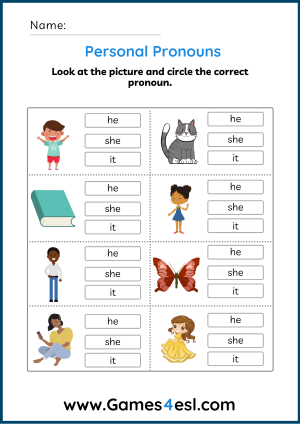
Personal Pronoun Worksheet – He, She, It
Students look at the pictures and circle the correct pronoun (he, she, or it).
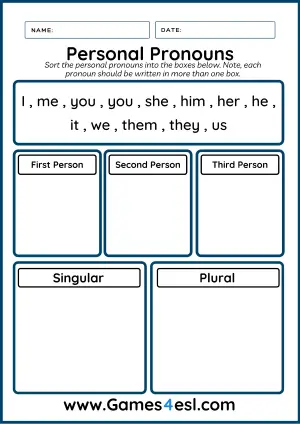
Personal Pronoun Sorting Worksheet
This activity asks students to sort pronouns like I, me, you, he, she, they, them, we, and us into categories (first/second/third person, singular/plural).

Personal Pronoun Worksheet – Fill in the Blank
Students read the short sentences and complete them with the correct pronoun (he, she, they, or we).
Possessive Pronoun Worksheets
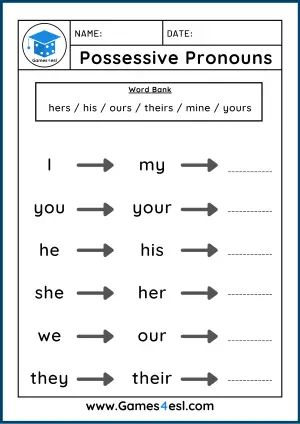
Possessive Pronoun Worksheet – Complete the Table
Students use the pronouns in the word bank to complete a chart with possessive pronouns (my, your, his, her, its, our, their) and independent possessive pronouns (mine, yours, his, hers, ours, theirs).
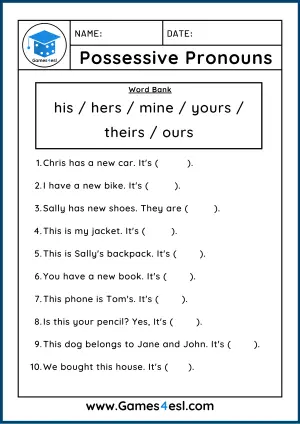
Possessive Pronoun Worksheet – Fill in the Blanks
Students read ten sentences and choose the correct independent possessive pronoun from the word bank to complete each one.

Identifying Possessive Pronouns Worksheet
This worksheet has 15 example sentences. Students read each one, find the possessive pronouns, and underline them.
Demonstrative Pronoun Worksheets
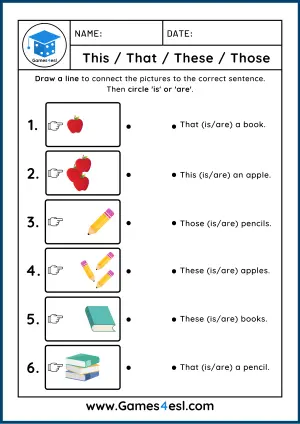
Demonstrative Pronoun Matching Worksheet
In this worksheet, students practice this, that, these, and those by matching sentences to the correct pictures. Then they choose the correct verb (is/are) to complete each sentence.
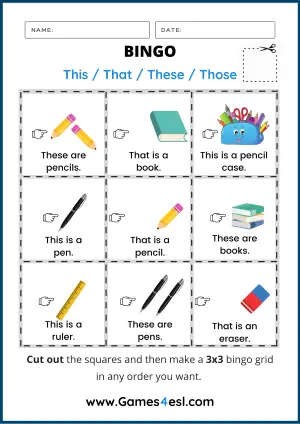
Demonstrative Pronoun Bingo Worksheet
This bingo-style activity helps students review demonstrative pronouns in a fun and interactive way. Students cut out the squares, arrange them in a 3×3 grid, and play bingo as they listen for this, that, these, and those.
How to Teach Pronouns with these Worksheets
These pronoun worksheets cover demonstrative, personal, and possessive pronouns. I usually start with demonstrative pronouns (this, that, these, those). Before using the worksheets, you can quickly show what these words mean by pointing at things in the classroom that are near (this/these) and far (that/those). This gives students a clear, simple introduction to using pronouns in place of nouns.
Once students are comfortable with demonstrative pronouns, it becomes much easier to introduce personal pronouns (he, she, it, they), as they are already used to replacing a noun with a word. At this stage, I explain that this/that/these/those are mainly used for things, while different pronouns are used for people. You can then introduce and practice personal pronouns, and use the worksheets above to practice.
Possessive pronouns are usually taught later. Before introducing them, it helps to make sure students are confident with personal pronouns like he and she, since these form the base for his and her. After teaching possessive pronouns, give students the worksheets above to practice and reinforce what they have learned.