
Action Verbs Lesson Plan for Beginners
In this action verbs lesson plan, students will learn and practice common action verbs through fun games and speaking activities. This lesson is designed for beginner English learners and helps students use action verbs to describe everyday actions like jump, run, eat, and more. All the materials you need to teach this lesson are included below.
Lesson Overview
- Objectives: Students will learn and practice common action verbs (e.g., jump, run, clap) and use them in simple sentences to describe what they and others can do or are doing.
- Key Expressions:
- “What can you do?” → “I can (jump).”
- “What is he/she doing?” → “He/She is (clapping).”
- “What do they do every day?” → “They (run) every day.”
- Who it’s for: Beginner English language learners.
- Duration: 40–50 minutes.
Introduce Action Verbs
Start the lesson by performing some simple actions and asking students to guess what you’re doing. For example, jump in the air and elicit the word “jump,” or clap your hands and elicit “clap.” Do this with 5 or 6 different actions, writing each one on the board as students guess.
Once you’ve listed a few verbs on the board, explain to students that these are called action verbs and they are words used to describe what someone is doing. Tell them that action verbs can describe both physical actions (like “run” or “kick”) and mental actions (like “think” or “dream”). Ask students if they know any other action verbs and add their suggestions to the board.
Next, use this Action Verbs PowerPoint to introduce the keywords for the lesson. Show each image and have students repeat the word after you. Go through them again and encourage students to say the words on their own. Continue until students are confident with the pronunciation and meaning.
Tip: To reinforce the vocabulary, play a quick miming game. Choose one student to come to the front, secretly show them an action verb, and have them act it out. The rest of the class guesses the verb. The student who guesses correctly takes the next turn. This is a great way to get students to connect the new words to real-life actions and helps them recall the new vocabulary.
Make Sentences With Action Verbs
Now that students have practiced the vocabulary, it’s time to show them how to use action verbs in sentences. Write jump and fly on the board and ask students, “Can you jump?” Then, encourage them to try jumping. Next, write the sentence “I can jump” on the board and have students repeat after you.
Then ask, “Can you fly?” Write “I can’t fly” on the board and again have students repeat after you. Next, elicit more ideas from students about things they can and can’t do, and write their suggestions on the board. For example, “I can read,” “I can eat,” “I can’t swim.” Practice each sentence together as a class. If this sentence structure is too easy for your class, here are some other sentence patterns you can use with action verbs:
- I can jump high.
- She is reading.
- They run every day.
Play an Action Verbs Board Game (Pair Work)
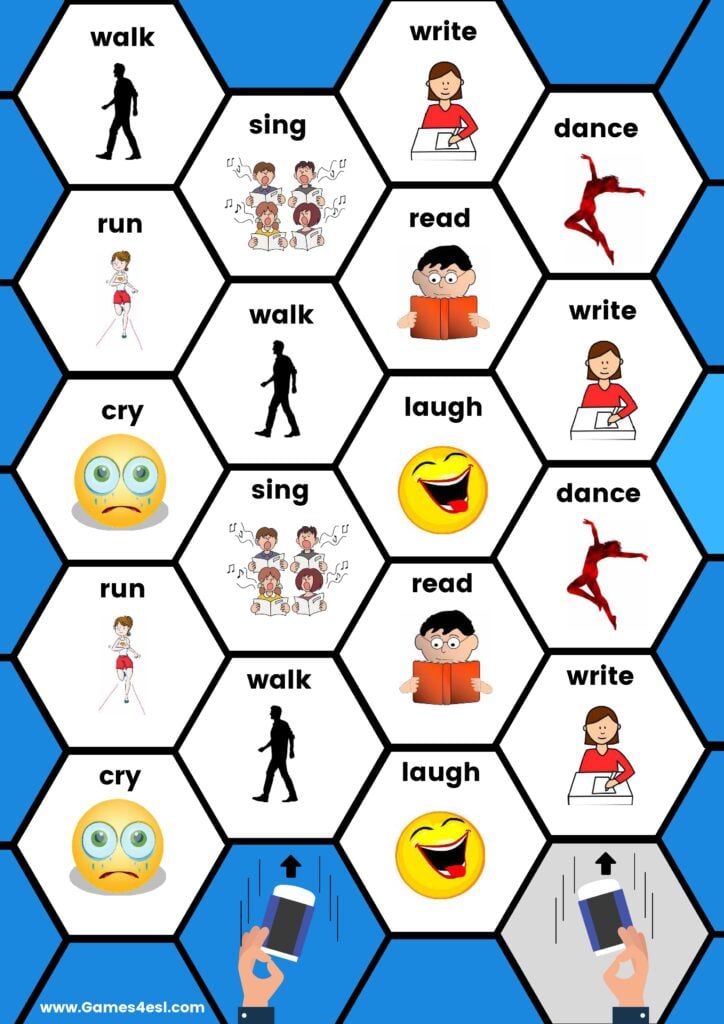
Download and print this action verbs board game and give one to each pair of students. To play, students take turns flicking their erasers up the board. If the eraser lands on an action verb, the student must make a sentence using that verb based on their own ability. For example, if it lands on “run,” the student might say, “I can run.” If it lands on “sing,” they might say, “I can’t sing.” After making a sentence, they mark or color in that space. Then it’s the other student’s turn. The game continues until all the spaces have been marked. The student with the most marked spaces at the end is the winner.
This activity works well because students are creating sentences that reflect their real abilities, so they’re using the target language in a meaningful and communicative way.
Complete an Action Verbs Worksheet
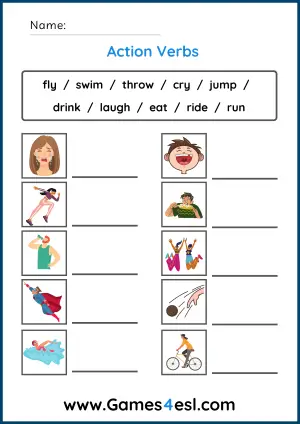
Next, it’s time to reinforce what students have learned with an action verb worksheet. Download and print this worksheet and give one to each student. To complete the worksheet, students must write the correct action verb next to each picture. For higher-level students, you can also ask them to write a full sentence using each verb. For example, next to a picture of someone jumping, they could write “I can jump.” For more exercises like this, see our Action Verb Worksheets page.
Review: Action Verbs Guessing Game

To review the lesson, play this fun action verbs guessing game. In each round, a picture of an action is slowly revealed, and students must guess the word as quickly as possible. Pause the video when students are ready to guess. Once they guess correctly, have the whole class repeat a sentence using the verb, such as “I can run,” “I can jump,” or “I can’t swim.” This simple game helps reinforce the vocabulary and gives students practice forming complete sentences with the target language.
More Action Verb Resources
Here are some more useful resources for teaching action verbs: