
Things That Come In Pairs in English | Vocabulary List with Examples
In English, some objects are always used in the plural form, even when we’re talking about just one item. That’s why we say a pair of trousers or a pair of scissors. This can be confusing for English learners, especially if their native language treats these words differently. Below is a list of things that come in pairs, along with a free poster for classroom use.
List of Things That Come In Pairs
| A pair of… | Example Sentence |
|---|---|
| scissors | She cut the paper with a pair of scissors. |
| glasses | He put on a pair of glasses to read the menu. |
| sunglasses | She wore a pair of sunglasses at the beach. |
| goggles | Swimmers wear a pair of goggles in the pool. |
| binoculars | We used a pair of binoculars to see the birds. |
| shorts | He bought a new pair of shorts for summer. |
| pants | I need a clean pair of pants for work. |
| trousers | He tried on a pair of trousers in the shop. |
| jeans | She bought a pair of jeans yesterday. |
| pajamas | She changed into a pair of pajamas before bed. |
| underwear | He packed a fresh pair of underwear. |
| knickers | She bought a pair of knickers at the store. |
| leggings | She wore a pair of leggings to the gym. |
| tights | She put on a pair of tights under her skirt. |
| stockings | The dancer wore a pair of stockings. |
| socks | He wore a new pair of socks. |
| shoes | She bought a pair of shoes for the party. |
| wellies | He wore a pair of wellies in the rain. |
| boots | She wore a pair of boots in the snow. |
| sandals | He wore a pair of sandals to the beach. |
| gloves | She put on a pair of gloves in winter. |
| earrings | She bought a pair of earrings for her friend. |
| earphones | He listened to music with a pair of earphones. |
| headphones | She bought a pair of headphones for studying. |
| earmuffs | He wore a pair of earmuffs in the cold. |
| pliers | He fixed the wire with a pair of pliers. |
| shears | The gardener used a pair of shears. |
| tongs | She picked up the ice with a pair of tongs. |
| clippers | The barber used a pair of clippers. |
| tweezers | She removed the splinter with a pair of tweezers. |
| handcuffs | The police officer used a pair of handcuffs. |
| chopsticks | She ate noodles with a pair of chopsticks. |
| roller skates | She wore a pair of roller skates at the rink. |
| ice skates | He rented a pair of ice skates at the arena. |
| skis | They bought a new pair of skis for the trip. |
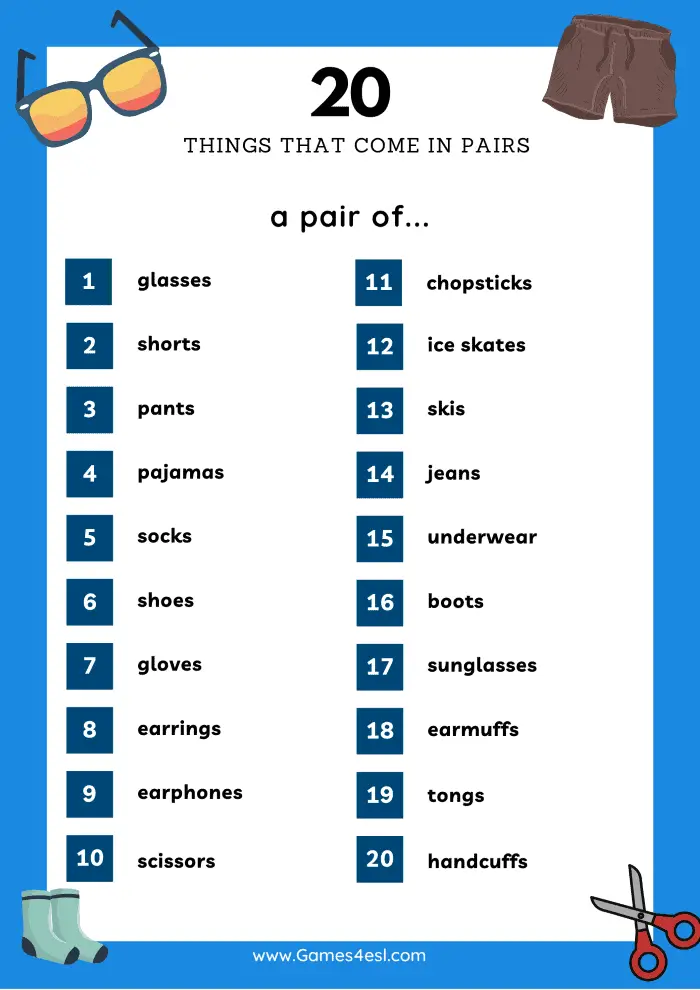
Things That Come In Pairs – Classroom Poster
To help students learn the things that come in pairs, here is a free classroom poster you can download and print.
Common Errors Learners Make
English learners often make predictable mistakes when using nouns that require a pair of. For example, it’s quite common to hear a student say a shorts instead of a pair of shorts, or a scissors instead of a pair of scissors. These mistakes usually happen because in many languages, these words are treated as singular or conceptualized differently. The best way to help students avoid fossilizing these errors is to introduce “pair” words early, give plenty of practice in natural contexts, and encourage frequent use in speaking and writing activities.
Activities To Learn Things That Come In Pairs
Here are some practical activity ideas that give learners repeated exposure to “pair” nouns. By practicing them in different contexts, students can build accuracy and confidence more quickly.
Sorting Activity
Create and print flashcards with a mix of singular and plural nouns. Challenge students to sort them into two groups. When they encounter words like scissors or shorts, they will notice that although the object is just one item, the word is used in the plural form. This gives you the chance to highlight the rule and show how we use a pair of to refer to just one.
Sentence Correction
Prepare a worksheet or write sentences on the board that use pair nouns incorrectly, such as “I have a scissors in my pencil case” or “She bought a trouser yesterday”. Students work individually or in pairs to spot and correct the errors. This activity helps draw attention to common mistakes and encourages self-correction, reinforcing the correct forms.
Find Somebody Who…
Turn pair nouns into a speaking game by using the question “Do you have…?”. For example, students walk around the room asking classmates questions like “Do you have a pair of headphones?” or “Do you have a pair of boots?”. Each answer gives them more practice producing full sentences with a pair of, and by the end of the activity, they will have repeated the target structure many times in natural conversation.