
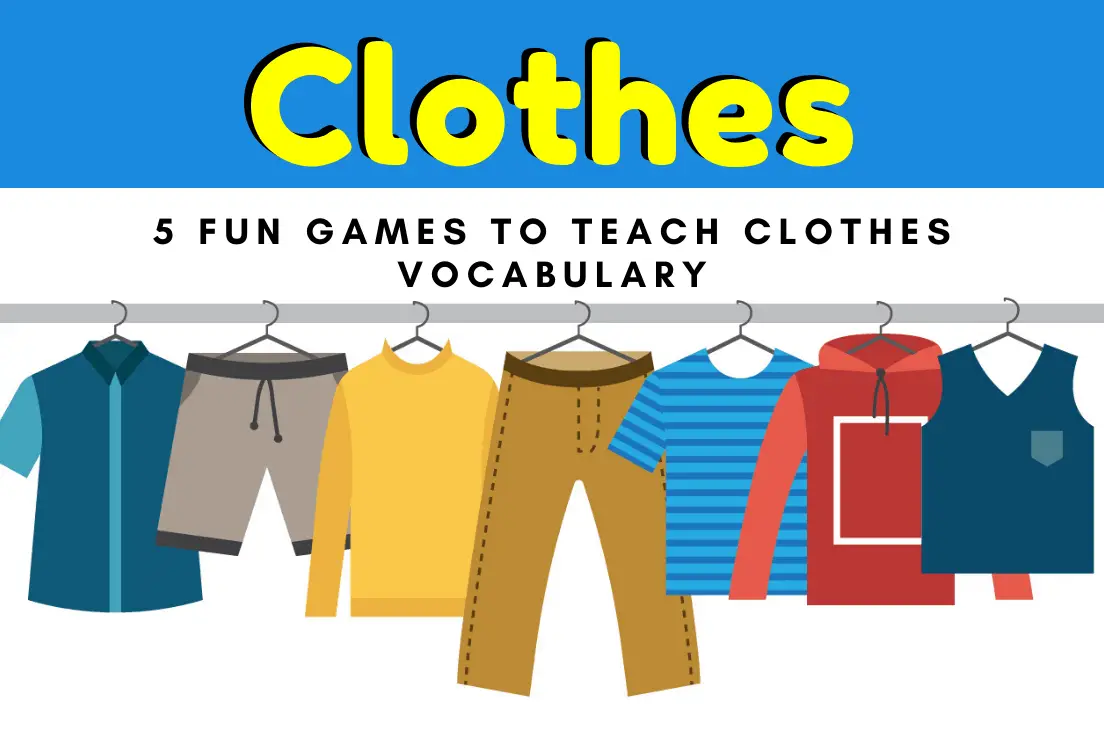
5 Super Fun Activities To Teach Clothes Vocabulary In English
If you’re teaching the names of clothes to kids or beginner ESL students, you’re going to need some fun activities.Below, you’ll find six of our favorite games for teaching clothes vocabulary. These work well for lessons using expressions like “What is she wearing?” and “She is wearing a red dress,” and can be adapted for a range of levels.
Activity 1: Guess the Item of Clothing
This guessing game is a fun way to introduce or review clothes vocabulary with young learners. Students see a colorful outline of an item of clothing and have five seconds to guess what it is before the answer is revealed. It works well as a warm-up to activate prior knowledge or as a quick review once the words have been taught.

How To Play
- Play the video in class.
- Pause before the answer if you want students to shout out or write their guess.
- Ask follow-up questions like “What color is it?” – “It’s a blue shirt.” to expand the activity and encourage learners to use full sentences.
Activity 2: Put On Your Hat, Please (Simon Says Game)
This variation of the classic classroom game Simon Says is a great listening activity to practice clothing words. Before starting this game, first teach the students how to mime putting on different items of clothing. For example, Put on your hat., Take off your hat., Put on your jacket., Take off your jacket., etc. Once students have practiced enough, it’s time to start the game.
In this game, if the teacher says please at the end of the sentence, then students should do the action. If the teacher doesn’t say please, then students should not do the action. For example, if the teacher says Put on your hat, please., then all students should mime putting on a hat. If the teacher just says Put on your hat., then students should not do anything.
If a student mimes putting on the item of clothing when the teacher didn’t say please, then that student is out and must sit down. Continue playing the game until only a few students are left standing. This game is a lot of fun, and kids really enjoy it. For more activities like this, check out these Games Like Simon Says.
Activity 3: Line Bingo

This fun ESL card game is a variation of bingo and can be played with any target language. To play this clothes bingo game, you need some small clothes flashcards for students to use. Download and print these clothes student cards and give one set to each student or pair of students. Next, ask students to place the clothes mini-flashcards in a horizontal line in any order that they want. Now the game can begin.
To begin, the teacher will choose one of the clothes flashcards and say the target expressions out loud. For example, ‘I want to buy a blue T-shirt.’ Then students should look at their clothes cards and if the blue T-shirt card is on the left end or the right end of the line of cards, then they can turn that card over. If the T-shirt card is in the middle of the line of cards, then the student cannot turn it over.
Then, the teacher should choose another card and say the sentence out loud (e.g., ‘I want to buy some shoes.’). And again, students should check if they can turn this card over. The first student to turn over all of his/her clothes flashcards has bingo and is the winner. This line bingo card game can be played with any target language if you have some small flashcards for students. You can download many student cards for FREE from our Flashcards Page.
Activity 4: Clothes Drawing Game
This activity to teach clothes vocabulary is a lot of fun, and your students will likely want to play this game several times once they see the funny result. To play, all you need is some pieces of A4 paper (or card), some scissors, and some coloring pens/pencils.
First, give each student a piece of paper. Assign a different piece of clothing for each of the students to draw. For example, one student will draw a hat, one student will draw a shirt, one student will draw trousers, etc. Tell students not to show their drawings to their friends. Once students have drawn their item of clothing, ask students to color it in and cut it out.
Once students have finished, draw a simple drawing of a man/woman on the board. Invite students one by one to come to the front and ‘dress’ the man/woman by placing their drawing in the right place on the board. Once all the drawings of the items of clothing are attached to the board, students will love the silly image they have created together.
TIP: After creating this drawing of a man/woman with different pieces of clothing, you can use it to drill the target language with the students. For example, ask students ‘What is he/she wearing?’, ‘He/She is wearing a blue hat, a yellow shirt, and red shoes.’, etc.
5: Clothes Hidden Picture Game
In this game, students see photographs of real clothing items hidden behind colored shapes. As the shapes disappear, they try to guess the item before it’s revealed. The use of real images makes it suitable for any age group.

How To Play
Play the video in class. Tell students to raise their hand as soon as they’re ready to guess, then pause the video to let them answer. If they’re correct, continue playing to reveal the answer; if not, allow another student to try.
To extend the activity, after each image is revealed, ask students to describe the item of clothing in more detail. Then, have them look around the classroom to see if anyone is wearing something similar. You can follow this up by practicing sentences like “He is wearing a…” or “She is wearing a…” to reinforce the vocabulary in context.
Related Clothes Lesson Materials
I hope your students enjoy playing these games. If you’re teaching a whole lesson on clothes, then here are some more useful resources you can use:
- Clothes Lesson Plan – A ready-to-use plan with activities, games, and vocabulary practice.
- Clothes Worksheets – Printable activities to reinforce clothes vocabulary and expressions.
- Clothes Flashcards – PDF Flashcards you can display in class or use to drill clothes vocabulary.
- Clothes Vocabulary List – A categorized list of clothing words for students to learn.