
Complete Clothes Lesson Plan (Games and Worksheets Included)
In this clothes lesson plan, students will learn clothes vocabulary and practice talking about what people are wearing. Students will also play a fun guessing game, and complete a worksheet to review the names of clothes in English. This clothes lesson plan is ideal for kids and beginner English language learners and is complete with all the materials you need.
Lesson Overview
- Objectives: Students will learn the names of common clothes in English and practice using them in simple sentences.
- Key Expressions:
- “What are you wearing?” → “I’m wearing a T-shirt.”
- “He/She is wearing a hat.”
- Who it’s for: Beginner ESL learners, especially kids, but activities can be adapted for older beginners.
- Duration: Around 40–60 minutes.
Step 1: Warm-Up with a Clothes Song
A fun way to start your clothes lesson is with a song. One great option is this clothes song by The Singing Walrus. Play the song and ask students to listen carefully for the clothing words they hear. After listening, ask them which words they remember and write these on the board. Then, invite students to add any other clothing words they already know. This is a simple and engaging way to activate their prior knowledge before moving on to learning new clothes vocabulary.
Step 2: Introduce the Key Words
Show students these clothes flashcards and ask them to repeat after you. Then go through them again and ask students to say each word on their own. Once they’re confident with the vocabulary, you can play a quick flashcard game to practice.
Attach the cards to the board and give students five seconds to memorize where each card is. Then, ask them to close their eyes while you remove one or two. When they open their eyes, ask: “What’s missing?”
This simple game not only makes reviewing vocabulary more fun, but it also strengthens students’ recall memory and helps them actively use the new words. Because they’re retrieving the words on their own, the vocabulary is more likely to stick.
Step 3: Clothes Guessing Game
Show students the video below. In each of the 10 rounds, they’ll see just the outline of a clothing item and they must guess what it is before the timer runs out.

You can easily adapt this activity depending on your students’ level and your lesson objectives:
- Whole-class vocabulary activity – Have students shout out the answer as soon as they recognize the item. This works best with absolute beginners who are focusing on learning the clothes names.
- Whole-class speaking prompt activity – With students who can use full sentences, expand each round into a mini speaking exercise. After the color image of the clothing item is revealed, pause the video and ask, “What color is it?” (e.g., “It’s a red T-shirt.”). Then, look around the classroom for a student wearing something similar and ask, “What’s he wearing?” (e.g., “He’s wearing a red T-shirt.”). This way, a simple vocabulary guessing game becomes a chance to practice descriptive sentences.
For more fun games to teach clothes in English, check out these 5 Fun Activities To Teach Clothes Vocabulary.
Step 4: Pair Work – Clothes Board Game
Now it’s time for students to work in pairs and practice using clothing vocabulary in full sentences while playing a fun board game. Download and print this clothes board game and give one copy to each pair. Each student will also need an eraser or other small object to use as their game piece.

The aim of the game is to “race around the world.” The first student to make it all the way around is the winner. One student moves clockwise, and the other moves counterclockwise.
To begin, both students place their game pieces on the “Start” space and play Rock, Scissors, Paper. The winner moves one square forward. After moving, the pair must have a short dialogue based on the picture in that square. For example:
Student A: “What are you wearing?”
Student B: “I’m wearing a T-shirt.”
This simple interaction gives students repeated speaking practice and helps them connect clothing vocabulary to meaningful questions and answers.
Step 5: Clothes Worksheet
Next, to reinforce what students have learned, give each student a copy of this clothes worksheet. Students should look at each picture, find the correct clothing word from the word box, and write it in the blank space.
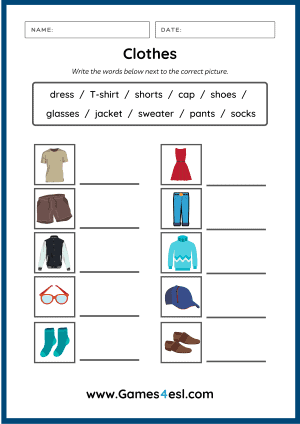
This activity gives students a chance to slow down and process the vocabulary in writing, which helps them retain the new words. For early finishers or higher-level learners, supply them with some additional activities from our clothes worksheets collection.
Step 6: Review
Finally, it’s time to review. A fun way to end a clothes lesson is to play Simon Says using the expression “Put on your (hat).” Show students how to mime putting on different items of clothing and practice several times together. Then explain that they should only follow your instructions when you begin with “Simon says…”.
For example, if you say “Simon says put on your hat,” students should mime putting on a hat. But if you just say “Put on your hat,” they should remain still. Any student who follows the instruction when you didn’t say “Simon says” is out and must sit down. Continue until only one student is left. That student is the winner.
Additional Resources to Teach Clothes Vocabulary
For more free resources for teaching about clothes in English, check out these related resources: