Months of the Year Lesson Plan
This ESL lesson plan is ideal for teaching the months of the year to kids and beginner English language learners (A1). Students will learn and practice the months in English through fun games, songs, speaking activities, and worksheets. All the lesson materials are available below.
Lesson Overview
- Objectives: By the end of the lesson, students will be able to identify and say the 12 months of the year in English and ask and answer simple questions.
- Key Words and Expressions:
- January, February, March, April, May, June, July, August, September, October, November, December
- “What month is it?” → “It’s (April).”
- “When is your birthday?” → “It’s in (February).”
- Level: Beginner (A1)
- Duration: 50–60 minutes
Introduce the 12 Months of the Year
A great way to introduce the months of the year is with a song. A quick search on YouTube will return many ESL songs for teaching the months, but we particularly like this song by KidsTV123.
First, play the song and ask students to listen and try to guess today’s topic. After listening once, ask students how many months there are and which months they already know. Then, play the song again and encourage students to sing along.
Next, elicit from students the name of the first month (January) and write it on the board. Then ask students what month comes next (February). Continue until all 12 months are written on the board in order. Finally, play the song one more time and have students sing along as you point to each month on the board.
TIP: If students find the song too slow, try increasing the playback speed on YouTube and see if students can keep up. This usually turns the activity into a fun challenge and gets the class laughing.
Practice Asking and Answering About the Months
Using this months PowerPoint, give students some practice asking and answering simple questions about the months of the year. Show each month one at a time and ask students, “What month is it?” Encourage students to answer in full sentences, such as “It’s February.” While using the PowerPoint, it’s also a good opportunity to point out that the names of the months always begin with a capital letter in English.
Months Listening Activity – Four Corners
I play this game a lot with my young learners, and they always love it because it gets them out of their seats and moving around the classroom. To play this game with the months of the year, first ask students what the first four months of the year are (January, February, March, and April). Then, assign one month to each corner of the classroom.

Next, secretly write down one of the four months on a piece of paper or mini whiteboard. Give students 5 seconds to move to the corner they think matches the month you chose. After 5 seconds, reveal the month. Students standing in the corresponding corner are out and must sit down.
Continue playing until only one student is left standing. That student is the winner. Then, play again using the next four months of the year, followed by the final four months.
TIP: This activity can get quite energetic, so before starting, remove any bags or other objects from the floor and remind students not to run or push while moving between corners.
Months Speaking Activity – When Is Your Birthday?
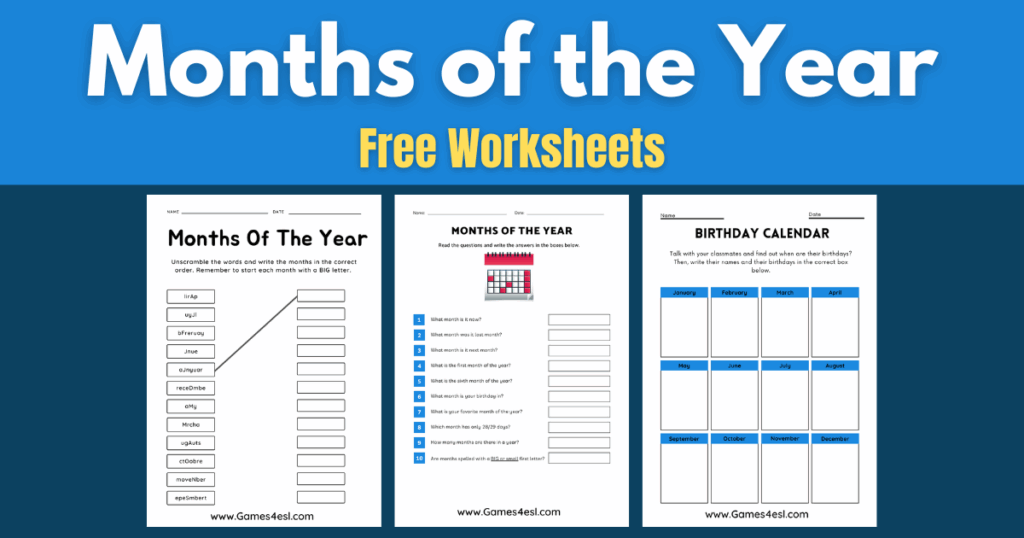
Introducing the topic of birthdays is a great way to practice the months in English. In this activity, students will ask and answer questions about birthdays while completing a class survey worksheet.

To begin, download and print this worksheet and give one to each student. First, ask students to find their own birthday month and write their name in the correct box. Then, teach students how to ask and answer questions about birthdays. For example:
“When is your birthday?”
“It’s in February.”
Once students are comfortable with the target expressions, have them stand up and walk around the classroom asking their classmates about their birthdays. Students should complete the worksheet by writing each classmate’s name in the corresponding month box. By the end of the activity, everyone’s worksheet should contain the same answers.
TIP: To encourage additional speaking practice, ask the class questions at the end of the activity such as, “When is Kelly’s birthday?” or “When is Chris’s birthday?” and have students answer together as a class.
Review Months of the Year
To review the months one final time, play the months of the year song again and encourage students to sing along. After the song, use a simple door check activity to review key expressions individually with students. Have students pack up their bags, push in their chairs, and line up at the door. Before each student leaves, ask them a question about the months of the year. For example, you can ask:
“When is your birthday?”
“What month comes after February?”
“What month comes before July?”
About the Author
Lesson plan by Craig Comer
Craig Comer is an experienced ESL teacher with over 10 years of classroom experience. He holds a Master’s degree in TESOL and specializes in creating practical resources for English language teachers.