
Prepositions of Place Lesson Plan for ESL Beginners (With Games & Activities)
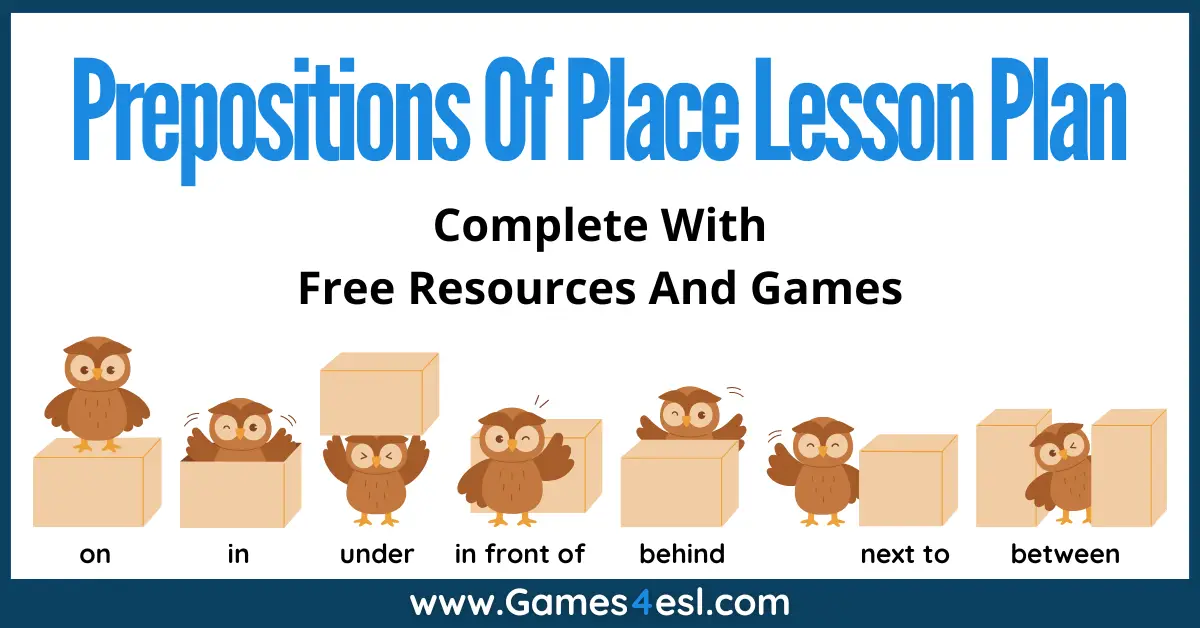
Prepositions of place are words we use to describe location, such as on, in, under, in front of, behind, next to, and between. They’re one of the easiest grammar points to demonstrate in the classroom, which makes them perfect for beginner ESL students.
With the right activities, teaching prepositions of place can be both fun and memorable. Kids especially enjoy learning them because they can act them out and connect the words directly to real-life objects.
On this page, you’ll find a complete step-by-step ESL lesson plan for teaching prepositions of place. It includes ready-to-use activities, games, and printable materials to get your students confidently using prepositions in no time.
Lesson Overview
- Objectives: Students will learn and practice common prepositions of place (on, in, under, in front of, behind, next to, between) and use them to describe where people and objects are.
- Key Expressions:
- Where is the (pen)? → It’s on the desk.
- Where is the (cat)? → It’s under the chair.
- Where is the (ball)? → It’s between the boxes.
- Who it’s for: Beginner ESL learners, especially kids in elementary classes. Activities can also be adapted for older beginners.
- Duration: Around 40–60 minutes, depending on class size and the number of activities used.
Step 1: Introduce Prepositions with Classroom Objects
Before teaching the keywords for the lesson, it’s important to put prepositions of place into context. This helps students understand what they are about to learn and activates their existing knowledge. Fortunately, prepositions of place are easy to demonstrate, and even young children can grasp the concept.
A simple way to do this is by using classroom objects. Place a pen in different locations and say the preposition aloud and ask students to repeat after you. For example:
- Place the pen on the desk → “on”
- Put it in the desk drawer → “in”
- Put it under the desk → “under”
Once students understand the idea, practice all the key words with these preposition flashcards. Show each card, drill the word together, and then ask students to say it on their own. To make it more interactive, place the flashcards around the classroom in matching positions. For example, place the “on” flashcard on a desk, the “under” flashcard under a book, and so on.
As you do this, ask students to repeat and remember where the cards are. At the end of the lesson, review by asking, “Where is the ‘on’ card?” and have students answer with the correct location, e.g., “It’s on the desk.”
Step 2: Sing a Preposition of Place Song
Songs are a fantastic way to help students internalize new vocabulary. Young learners especially love singing and moving, and music makes abstract concepts like prepositions much easier to remember. Start by choosing a song that fits your students’ level. For very young learners, it’s best to keep it simple with the basic prepositions of on, in, and under. This song works well for beginners. If your lesson includes more prepositions such as in front of, behind, next to, and between, then try this song, which introduces all of them in context.
How to Teach the Song
When introducing the song, play it once without asking students to sing along. Encourage them to listen carefully for any words they already recognize. Then, go back and teach the lyrics in small sections. Play a short part of the song, pause it, and have students repeat after you. Don’t worry about being a great singer. What matters is showing your students that you’re willing to join in.
Once they’ve practiced the lyrics, sing the whole song together. To make the activity even more engaging, add simple gestures for each preposition. For example, when singing on, place one hand on top of the other; for under, put your hand beneath your fist; and so on. These movements help students connect the word with its meaning and make the prepositions much more memorable for young learners.
If your students enjoy music in class, you can find more ideas in our post on the Best ESL Songs for Young Learners.
Step 3: Speaking Activity – Race Around the World Board Game
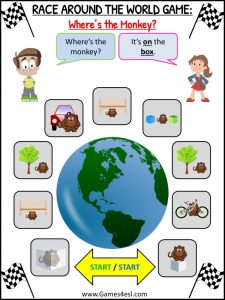
Board games are a fantastic way to get students practicing target language in a fun, low-pressure setting. This activity works best in pairs and gives students repeated practice forming sentences with prepositions of place. The goal of the game is simple: be the first to “race around the world.” You’ll need one copy of the prepositions board game for each pair of students.
How to Play
Give each student a small counter or an eraser to use as their game piece. Both players place their counters at the “Start” space on the board. One player will move clockwise and the other counter-clockwise.
Students play Rock–Scissors–Paper to decide who goes first. The winner moves their counter one square forward. After moving, the pair makes a dialogue based on the picture in that square. For example:
- Student A: “Where is the monkey?”
- Student B: “It’s under the bench.”
They then play Rock–Scissors–Paper again, and the cycle continues. The first player to make it all the way around the board wins.
If pairs finish quickly, you can keep the game going by telling them that reaching the finish earns one point, and the first player to collect five points is the overall winner.
For more printable board games on many topics, check out our Board Games and Templates page.
Step 4: Prepositions Memory Game
This activity is an engaging way to review prepositions of place once students are already comfortable forming sentences. It combines memory, observation, and speaking, which keeps learners focused and motivated.

How to Play
Play the video for your class. Each round shows a scene for about five seconds, and students must look carefully and remember where the objects are. After the scene disappears, a question will appear on the screen such as, “Where is the baseball bat?” followed by three multiple-choice answers.
Decide how you want your students to respond:
- For speaking practice, ask them to raise their hands when ready and answer aloud using full sentences, e.g., “It’s under the table.”
- For writing practice, have students write their answers in their notebooks before checking as a group.
The game continues through ten questions, giving students multiple opportunities to recall vocabulary and use prepositions of place in context.
Step 5: Review
At the end of the lesson, review what students have learned by asking them to recall where the preposition flashcards were placed around the classroom at the beginning of class. For example, ask, “Where is the ‘on’ card?” or “Where is the ‘under’ card?” Students should answer using the target expressions, such as, “It’s on the desk,” or “It’s under the book.”
This memory-based review encourages students to actively retrieve what they’ve learned and ensures they can use the vocabulary and expressions correctly before the lesson finishes.
Additional Prepositions of Place Resources
Check out these additional resources for more ways to teach prepositions of place.