
Present Progressive Tense: Spelling Rules & Examples
The present progressive tense is one of the first verb forms beginner English learners study. It is used to talk about actions happening now, but many students find it tricky to form correctly, especially when it comes to spelling.
On this page, you’ll find clear present progressive spelling rules, along with simple examples to help students understand how to form and use the tense correctly. These rules will help learners avoid common mistakes and build confidence when talking about actions happening at the moment.
Present Progressive Tense Spelling Rules

When changing a verb into the present progressive tense, there are certain spelling rules to follow. Here is a list of present progressive examples and the spelling rules for changing a verb into the present progressive tense.
Most Verbs
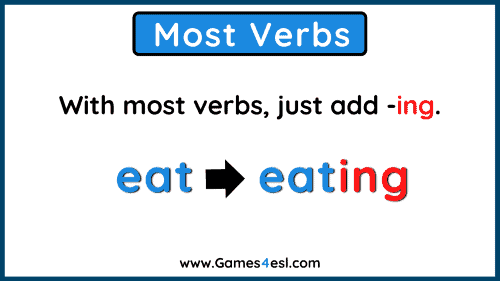
With most verbs, to make the present progressive tense, simply add -ing to the base form of the verb. For example, the verb eat becomes eating in the present progressive tense.
Here are some present progressive examples with example sentences which follow this rule:
- eat – eating – I am eating a sandwich.
- watch – watching – Kelly is watching a movie.
- cook – cooking – Mom is cooking a delicious dinner.
- do – doing – She is doing her homework.
- play – playing – He is playing computer games
- talk – talking – They are talking on the phone.
- read – reading – Tom is reading quietly.
- study – studying – We are studying English.
- start – starting – Hurry up! The movie is starting.
- show – showing – Chris is showing his friends around his house.
- rain – raining – It is raining outside.
- learn – learning – The students are learning English in the classroom.
- clean – cleaning – Tom is cleaning his bike.
- wash – washing – Dad is washing the dishes.
- wait – waiting – I am waiting at the bus stop.
Verbs Ending in e
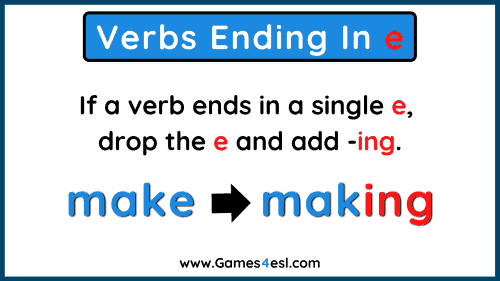
With verbs that end in e, to make the present progressive tense, drop the e and add –ing. For example, the verb make becomes making in the present progressive tense.
Here are some present progressive examples and example sentences which follow this rule:
- make – making – Mom is making a cake.
- smile – smiling – She is smiling.
- write – writing – Chris is writing a letter to his friend.
- drive – driving – Dad is driving a car.
- take – taking – I am taking a shower.
- have – having – Chris and Kelly are having breakfast.
- type – typing – I am typing on the keyboard.
- shave – shaving – Dad is shaving off his beard.
- shake – shaking – The dog is shaking because it is so cold.
Verbs Ending In ie

When a verb ends in ie, to change the verb into the present progressive tense, change the ie for y and add -ing. For example, the verb die becomes dying in the present progressive tense.
Here are some present progressive examples and example sentences which follow this rule:
- die – dying – The plant is dying because I forgot to water it.
- lie – lying – I think she is lying.
- tie – tying – Chris is tying his shoelaces.
Verbs Ending In A Consonant Preceded By A Vowel

With most verbs that end in a consonant preceded by a vowel, double the consonant and add -ing. For example, the verb swim ends in a consonant (m) and is preceded by a vowel (i). So, to change swim into the present progressive tense, we must double the consonant m and add -ing. Swim becomes swimming.
Here are some present progressive examples and example sentences which follow this rule:
- swim – swimming – Kelly is swimming in the lake.
- run – running – Chris is running as fast as he can.
- stop – stopping – The bus is stopping.
- get – getting – It’s getting really hot in here.
- put – putting – Mom is putting more icing on the cake.
*Note: When the final consonant is y or w and is preceded by a vowel, the consonant is not doubled (e.g. buy – buying / snow – snowing)
Two-Syllable Verbs
With two-syllable verbs the present progressive rule is a little different. If the second syllable in a two-syllable verb is stressed, then the last consonant is doubled. For example:
- upset – upsetting
- forget – forgetting
- commit – committing
If the first syllable in a two-syllable verb is stressed, then the consonant is NOT doubled. For example:
- whisper – whispering
- visit – visiting
- benefit – benefiting
Present Progressive Teaching Resources
- Present Progressive Tense PowerPoint
- Present Progressive Tense Worksheets
- Present Progressive Tense Flashcards
- Present Progressive Tense Games