
5 Fun Present Progressive Tense Games for Class
One of the most effective ways to teach the present progressive tense is through interactive classroom games. Instead of repeating grammar drills, these engaging activities give students a chance to use present progressive sentences, like “She is singing” or “They are running,” in fun and meaningful ways. Below, you’ll find a collection of easy-to-use games that help students understand and practice the present progressive tense with confidence.
Present Progressive Guessing Game
This first activity is a fun video you can use to introduce or review the present progressive tense. Students will see pictures of people doing different actions and must answer questions like “What’s he doing?”, “What’s she doing?”, and “What are they doing?” using full present progressive sentences.

How to Play
Play the video in class and pause when you reach the key expressions. This is a good moment to practice the target language with students before the game begins. For example, review how to answer:
- “What’s he doing?” → “He is running.”
- “What’s she doing?” → “She is running.”
- “What are they doing?” → “They are running.”
Once students are confident, press play to begin the first round.
There are 10 rounds in total. In each round, students will see an image of real people doing something. As the colored shapes disappear, they must guess the action by saying sentences like “He is jumping,” or “They are dancing.” Pause the video when students are ready to guess. This activity is very versatile and can be adapted to suit your lesson goals. For example:
- Warm-up: Ask students to raise their hands when they’re ready to guess.
- Writing practice: Pause after a few tiles are removed and have students write down the full present progressive sentence.
Present Progressive Charades
Charades is a classic classroom game that works perfectly for practicing the present progressive tense. It gets students moving, laughing, and speaking, all while using present progressive sentences in context.
To play this game, you’ll need a set of action words that end in -ing. You can either write some verbs on pieces of paper or use these ready-made Present Progressive Flashcards featuring common actions like running, reading, eating, and more.
How to Play
- Divide the class into two teams.
- Invite one student from a team to come to the front. This student will act out words for their teammates to guess.
- Start a 30-second timer and show the student a flashcard.
- Without speaking, the student must act out the action on the flashcard (e.g., mime singing).
- The rest of their team must guess the sentence by answering, “He is dancing” or “She is dancing,” depending on the student.
- Once they guess correctly, show the next flashcard. Keep going until the time runs out.
- Count the number of correct guesses, and then switch to the other team.
- The team with the most correct answers is the winner.
What makes this game so effective for practicing the present progressive tense is that it gets students using full sentences to actually describe what someone is doing right now, just like they would in real-life situations. This reinforces both the structure and meaning of the tense in a fun, memorable way.
Present Progressive Video Quiz
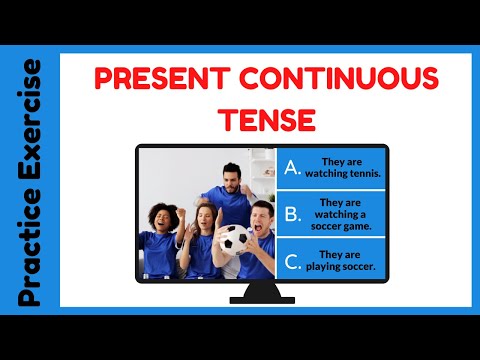
This next activity is a multiple-choice video quiz designed to help students recognize and understand present progressive sentences in context. This activity works well after students have learned the present progressive structure and are ready to start producing a wider range of sentences on their own.
How to Play
Play the video in class. There are 10 rounds. In each round, students will see a short video clip of someone doing an action, such as running, painting, or climbing, followed by three multiple-choice sentences. Students must choose the correct present progressive sentence that matches the action in the video.
For beginners who aren’t yet confident making full sentences on their own, simply ask them to choose A, B, or C, and then repeat the correct sentence after you. For more advanced learners, ask them to write their answers as full sentences, either in their notebooks or on mini whiteboards, to get extra writing and sentence-building practice.
Present Progressive Memory Game
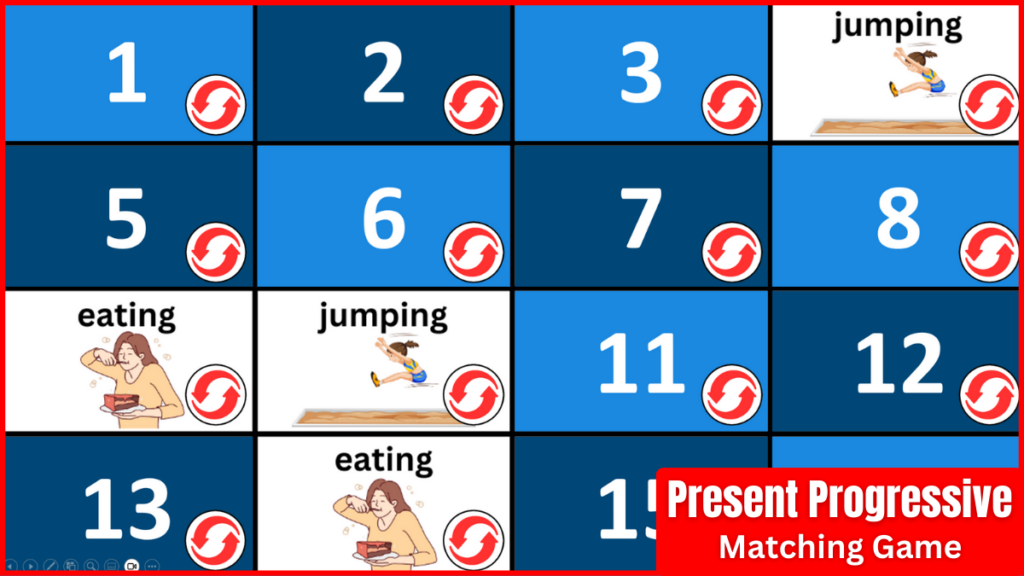
This PowerPoint memory game is perfect for beginner students who need more practice recognizing present progressive verbs. It’s simple to use and helps reinforce the target language through repetition.
How to Play
Download the Present Progressive Tense Memory Game PPT and start the slide show. Next, put students into two teams. Choose one player from each team to play rock-paper-scissors to decide who goes first. Then, teams take turns choosing two squares from the game board.
Click on the chosen squares to reveal the present progressive verb underneath (e.g., running). If the two squares show the same verb, that team gets a point. If they don’t match, click the red circle to flip the cards back over, and it’s the other team’s turn. Continue until all the pairs have been found. The team with the most matches at the end is the winner.
Kids especially enjoy this game and will likely want to play again in future lessons. You can find more memory games like this and an editable template to add your own words on our Memory Game PowerPoint page.
Present Progressive Narration Activity
This role-play activity is ideal for students who are already confident using present progressive sentences and are ready to apply them in longer, more creative contexts. It gives learners the chance to practice using the tense beyond single verbs and short answers by describing a full sequence of ongoing actions.
How to Play
Divide the class into small groups (3 to 4 students). Give each group a common scenario to base their role-play on. For example, lunchtime, at the supermarket, on the playground, or English class. You can assign the same scenario to all groups, or give each one a different situation to add variety. Each group should write a short narrated story using present progressive sentences. Next, one student in the group will act as narrator and read the story, and the other students in the group must act it out.
Example Narration:
“This is Chris. Chris is eating a sandwich. He is really enjoying it. Suddenly, a dog comes in and steals Chris’s sandwich! Chris is chasing the dog. He is running very fast, but he can’t catch it. Now Chris is crying.”
This activity often leads to funny and imaginative stories, and students usually love performing them in front of the class. However, some learners may feel nervous acting in front of others. So, to help build confidence and keep the energy positive, encourage the audience to clap and cheer for each group after their performance.
Present Progressive Board Game
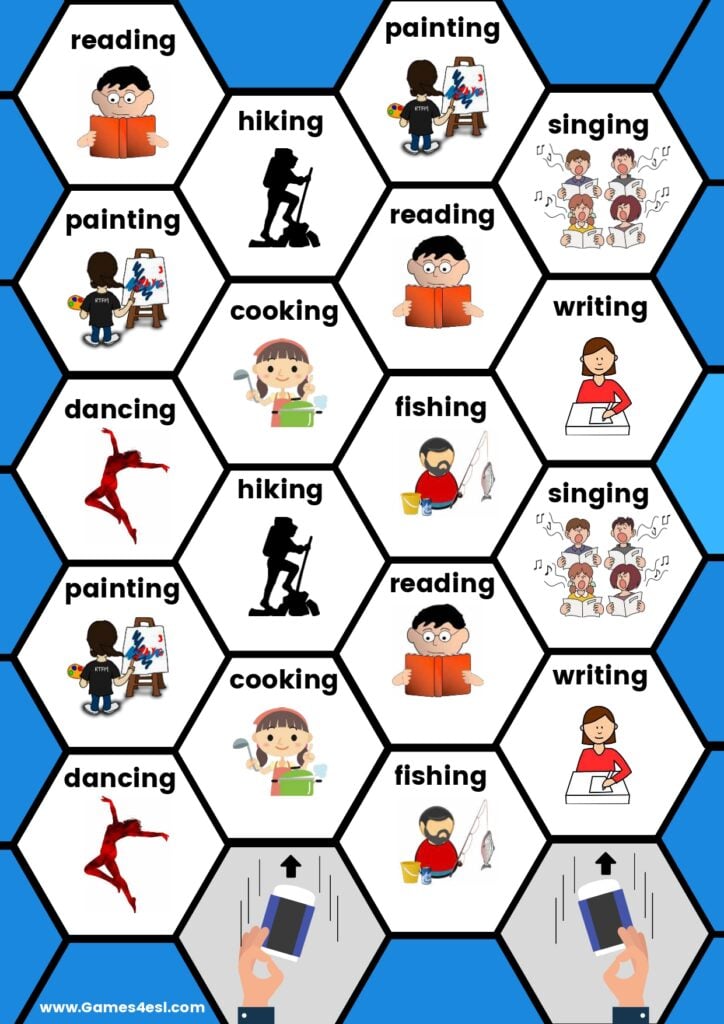
This printable board game is best played in pairs and gives kids plenty of practice saying present progressive sentences like “I am dancing” or “I am eating.”
How to Play
Download and print this board game and give one to each pair of students. Each student needs a small object to flick, such as an eraser or coin. Students take turns placing their erasers at the bottom of the game board and flicking them with their fingers. If it lands in a space with a present progressive word or picture (e.g., eating), their partner asks, “What are you doing?” The student must then answer and act it out (for example, “I am eating.”).
While students are playing and making dialogues with their partners, you can walk around the class and listen for common mistakes you may need to review later. For example, some students may say “He dancing” instead of “He is dancing.”
Supporting Materials
I hope your students have lots of fun playing these games. To help you prepare a full lesson on the present progressive tense, we have these other useful resources:
- Present Progressive PowerPoint Lesson
- Present Progressive Tense Flashcards
- Present Progressive Tense Worksheets
- A Complete ESL Present Progressive Tense Lesson Plan
About the Author
Written by Craig Comer
Craig Comer is an experienced ESL teacher with over 10 years of classroom experience. He holds a Master’s degree in TESOL and specializes in creating practical resources for English language teachers.