
Comparative Adjectives Lesson Plan
This lesson plan teaches comparative adjectives and how to use them to compare two things in English. Students begin with a song to hear comparatives in context, then learn how to form them by changing adjectives into their comparative form. After that, they practice making sentences with a fun quiz and complete a worksheet to reinforce what they’ve learned. All the materials needed for this lesson, including a PowerPoint, worksheet, and activity video, are provided below.
Lesson Overview
- Objectives: Students will learn how to form comparative adjectives and use them to compare two things. They will practice making sentences in both guided and interactive activities.
- Key Expressions:
- “Which is faster”
- “A motorbike is faster than a cheetah.”
- “Who is taller?”
- “Kelly is taller than Chris”
- Who it’s for: Beginner ESL/EFL students (suitable for both kids and teenagers).
- Duration: 45–60 minutes.
Warm Up With a Comparatives Song
Start the lesson with a fun song to introduce the idea of comparatives. A great choice is Harder, Better, Faster, Stronger by Daft Punk, but you can use any song that features comparatives. Play the song for the class and ask students to listen carefully for words ending in “-er.” Write these words on the board as students call them out.
Once you have a list of words, explain that these are comparative adjectives and are used to compare two things. Demonstrate this with a simple activity. Elicit the adjective tall and invite two students to the front of the class. Have them stand back-to-back to check their height, then ask the class to identify which student is taller. Repeat with short to reinforce the concept.
Teach How to Form Comparative Adjectives

Use this Comparatives PowerPoint to teach how to form comparative adjectives (or write examples on the board if you prefer). Explain the rules for changing adjectives into their comparative form:
- Most short adjectives: Add –er (tall → taller, fast → faster).
- Short adjectives ending in a single vowel + consonant: Double the final consonant and add –er (hot → hotter, big → bigger).
- Adjectives ending in –y: Remove the y and add –ier (happy → happier, busy → busier).
- Longer adjectives (two or more syllables, not ending in –y): Use more + adjective (beautiful → more beautiful, expensive → more expensive).
- Irregular adjectives: These don’t follow the rules (good → better, bad → worse, far → farther).
Tip: Students won’t be able to memorize all these rules right away. Write them on the board or display them somewhere in the classroom so students can refer back to them throughout the lesson (and in future lessons) as they practice.
Practice Comparative Sentences With a Quiz
Now that students are familiar with what comparatives are and how to form them, it’s time to practice making full sentences. The quiz video below has 10 rounds. In each round, students see two things and must compare them using a comparative adjective. Play the video in class and pause after each question to give students time to answer. Encourage them to respond in full sentences, for example: “A motorbike is faster than a cheetah.”

Practice Writing Comparative Sentences
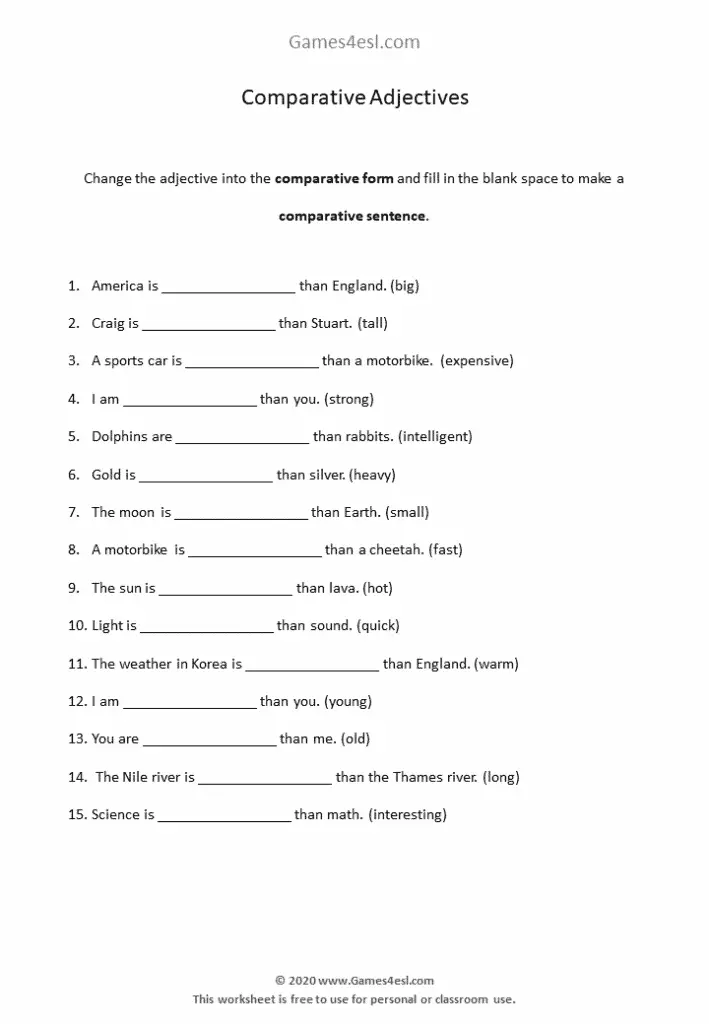
Next, reinforce what students have learned with a worksheet activity. Download and print this comparative exercise worksheet and give one to each student. The worksheet includes 15 sentences with the adjective missing. Students must write the correct comparative adjective in the blank to complete each sentence. After students finish, check the answers together as a class. This not only reviews the rules but also helps identify any common mistakes that may need extra practice.
Review With a Game: Comparative Olympics
Before finishing the lesson, review how to form comparative adjectives and make comparative sentences. Use the same PowerPoint to quickly revisit the rules, then play Comparative Olympics. To play, write a set of adjectives on slips of paper and place them in a bowl or container. Invite two students to the front of the class. One student draws an adjective at random, and the class compares the two students using that word. For example:
- If the word is tall, compare their heights and ask, “Who is taller?”
- If the word is fast, have them do a quick spelling race and ask, “Who is faster?”
Continue with different students and adjectives until everyone has had a turn. This simple activity gives students repeated practice using the comparative forms they learned in the lesson and helps reinforce the new language in a fun way.
More Comparative Resources for Your Lessons:
I hope you found this comparative adjectives lesson plan useful. Before you go, be sure to check out the related articles and resources below for teaching comparatives in English.